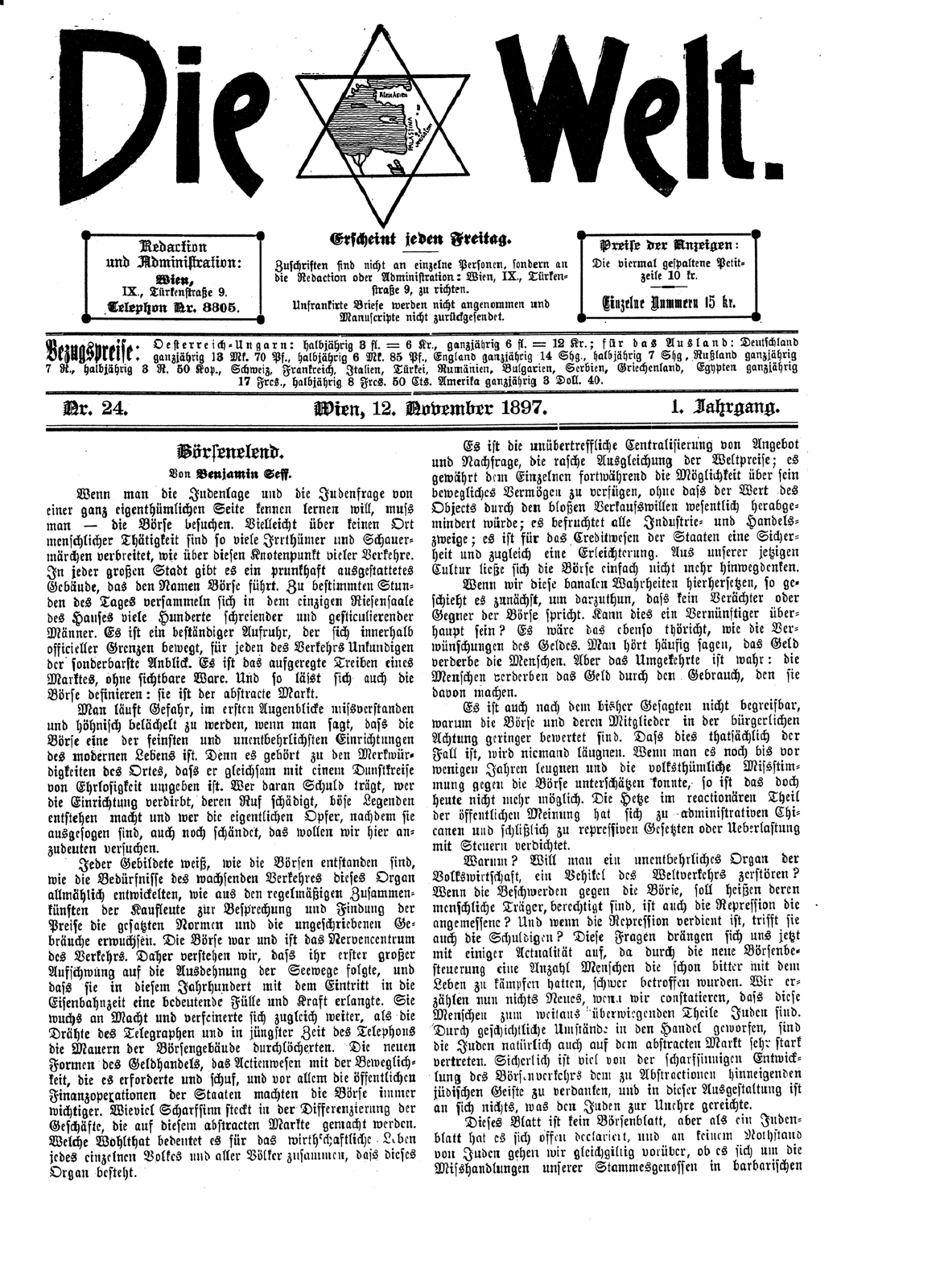
Die Welt.
Appears every Friday.
Editorial Office and Administration: Vienna, IX., Türkenstraße 9. Telephone No. 8805.
Communications are to be addressed not to individual persons, but to the Editorial Office or the Administration: Vienna, IX., Türkenstraße 9.
Unstamped letters will not be accepted, and manuscripts will not be returned.
Advertising rates: The four-column petit line, 10 kr.
Single numbers 15 kr.
Subscription rates: Austria-Hungary: half-yearly 3 fl. = 6 Kr., yearly 6 fl. = 12 Kr.; for abroad: Germany yearly 13 Mk. 70 Pf., half-yearly 6 Mk. 85 Pf.; England yearly 14 shg., half-yearly 7 shg.; Russia yearly 7 R., half-yearly 3 R. 50 kop.; Switzerland, France, Italy, Turkey, Roumania, Bulgaria, Servia, Greece, Egypt yearly 17 frcs., half-yearly 8 frcs. 50 cts.; America yearly 3 doll. 40.
No. 24. Vienna, 12 November 1897. 1st Year of Issue.
The Misery of the Bourse.
By Benjamin Seff.
If one wishes to know the condition of the Jews and the Jewish question from a wholly peculiar side, one must — visit the Bourse. Concerning perhaps no other place of human activity are so many errors and lurid fables current as concerning this junction of many kinds of traffic. In every great city there stands a sumptuously appointed building that bears the name of Bourse. At certain hours of the day there gather in the single vast hall of the house many hundreds of shouting and gesticulating men. It is a perpetual tumult that moves within official bounds, to anyone unversed in this traffic the strangest of spectacles. It is the agitated bustle of a market without visible wares. And so the Bourse may indeed be defined: it is the abstract market.
One runs the risk of being misunderstood at the first moment, and smiled at with derision, if one says that the Bourse is one of the finest and most indispensable institutions of modern life. For it belongs among the singularities of the place that it is enveloped, as it were, in an atmosphere of dishonour. Who bears the blame for this, who corrupts the institution, damages its repute, gives rise to evil legends, and who, moreover, defames the real victims after they have been sucked dry — that is what we shall here attempt to indicate.
Every educated man knows how the Bourses arose, how the needs of a growing traffic gradually developed this organ, how out of the regular meetings of merchants for the discussion and determination of prices there grew the established norms and the unwritten usages. The Bourse was and is the nerve-centre of commerce. We therefore understand that its first great expansion followed upon the extension of the sea routes, and that in this century, with the entry into the railway age, it attained a notable fulness and power. It grew in might and at the same time refined itself further, when the wires of the telegraph and, in the most recent time, of the telephone pierced the walls of the Bourse buildings. The new forms of the money trade, the joint-stock system with the mobility it required and created, and above all the public financial operations of the States, made the Bourse ever more important. How much acuteness lies in the differentiation of the transactions that are made upon this abstract market. What a benefaction it is for the economic life of every single people, and of all peoples together, that this organ exists.
It is the unsurpassable centralisation of supply and demand, the swift equalisation of world prices; it affords the individual the continual possibility of disposing of his movable property without the value of the object being materially diminished by the mere will to sell; it fructifies every branch of industry and commerce; it is at once a security and a facility for the credit system of the States. From our present civilisation the Bourse simply can no longer be thought away.
If we set down these banal truths here, it is done in the first place to show that it is no despiser or adversary of the Bourse who speaks. Can a reasonable man be such a thing at all? It would be as foolish as the imprecations against money. One often hears it said that money corrupts men. But the reverse is true: men corrupt money by the use they make of it.
Neither is it comprehensible, after what has thus far been said, why the Bourse and its members should stand lower in civic esteem. That this is in fact the case no one will deny. If, up to a few years ago, one could still deny it and underrate the popular ill-humour against the Bourse, that is no longer possible to-day. The agitation in the reactionary portion of public opinion has condensed itself into administrative chicanery and finally into repressive laws or overburdening with taxes.
Why? Is it desired to destroy an indispensable organ of the national economy, a vehicle of the world's commerce? If the grievances against the Bourse — which is to say, against its human bearers — are justified, is repression also the appropriate remedy? And if the repression is deserved, does it strike the guilty? These questions press upon us now with a certain actuality, since through the new taxation of the Bourse a number of persons who already had bitterly to struggle with life have been gravely afflicted. We relate nothing new when we state that these persons are, by far the preponderant part, Jews. Cast by historical circumstances into trade, the Jews are naturally very strongly represented upon the abstract market as well. Assuredly much of the acute development of Bourse traffic is to be credited to the Jewish spirit with its leaning towards abstractions, and in this shaping there is in itself nothing that could redound to the dishonour of the Jews.
This paper is no Bourse paper, but it has openly declared itself a Jewish paper, and we pass by no distress of Jews with indifference, whether it be a question of the ill-treatment of our kinsmen in barbarous