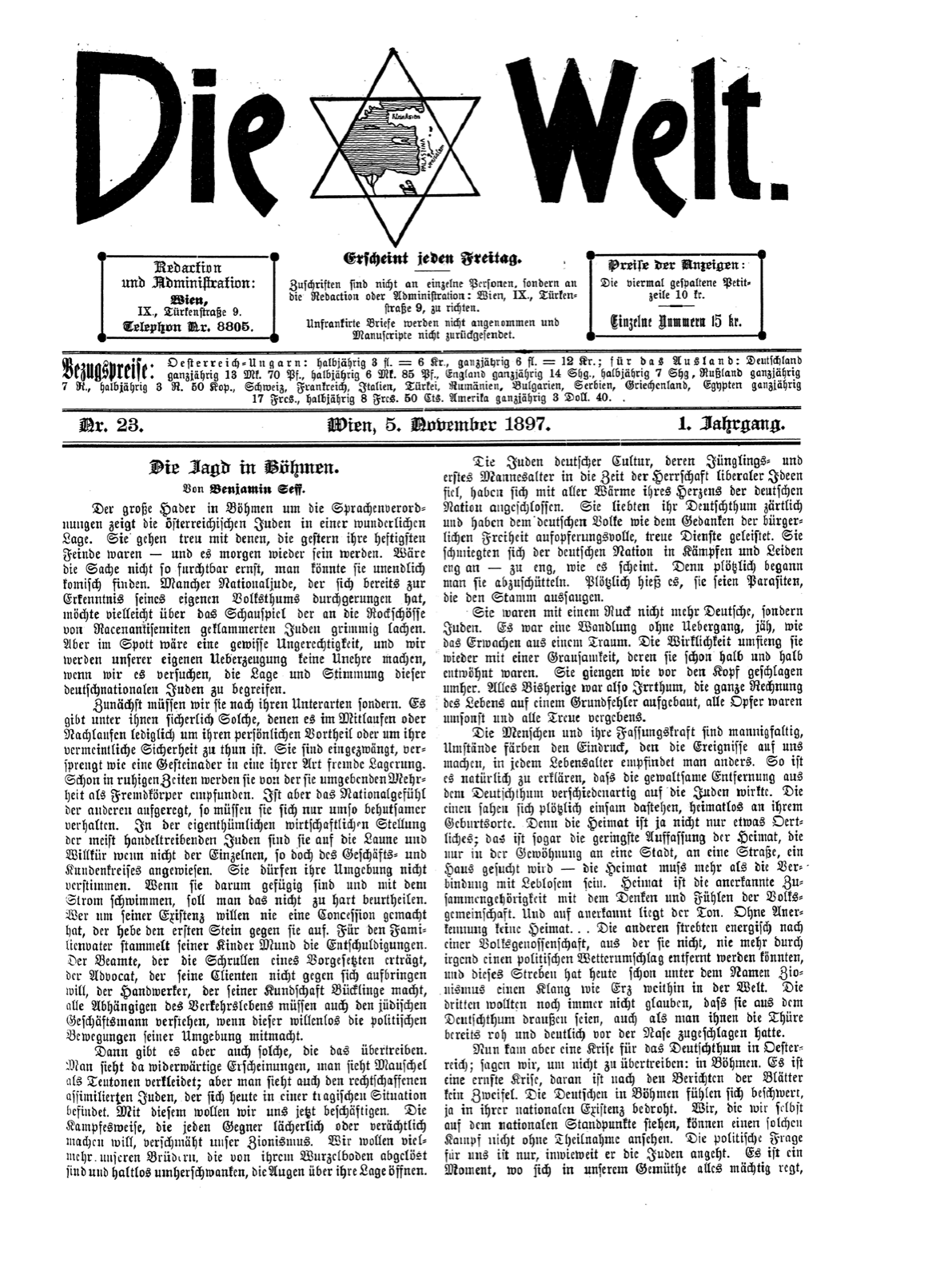
Die Welt.
Appears every Friday.
Editorial Office and Administration: Vienna, IX., Türkenstraße 9. Telephone No. 8805. — Communications are to be addressed not to individual persons, but to the Editorial Office or the Administration: Vienna, IX., Türkenstraße 9. Unfranked letters are not accepted, and manuscripts are not returned. — Advertising rates: the four-column petit line 10 kr. Single numbers 15 kr.
Subscription prices: Austria-Hungary: half-yearly 3 fl. = 6 Kr., yearly 6 fl. = 12 Kr.; for abroad: Germany yearly 13 Mk. 70 Pf., half-yearly 6 Mk. 85 Pf., England yearly 14 Shg., half-yearly 7 Shg, Russia yearly 7 R., half-yearly 3 R. 50 Kop., Switzerland, France, Italy, Turkey, Roumania, Bulgaria, Servia, Greece, Egypt yearly 17 Frcs., half-yearly 8 Frcs. 50 Cts. America yearly 3 Doll. 40.
No. 23. | Vienna, 5 November 1897. | 1st Year.
The Hunt in Bohemia.
By Benjamin Seff.
The great strife in Bohemia over the language ordinances shows the Austrian Jews in a singular position. They march faithfully with those who yesterday were their bitterest enemies — and who tomorrow will be so again. Were the matter not so terribly serious, one might find it infinitely comical. Many a national Jew who has already fought his way through to a recognition of his own peoplehood might well laugh grimly at the spectacle of Jews clinging to the coat-tails of racial anti-Semites. But there would be a certain injustice in mockery, and we shall do no dishonour to our own conviction if we attempt to understand the position and the temper of these German-national Jews.
First of all we must separate them according to their sub-species. There are certainly some among them to whom running along or running after is merely a matter of personal advantage or of their supposed security. They are wedged in, scattered like a vein of rock in a bed foreign to its kind. Even in quiet times they are felt as a foreign body by the majority that surrounds them. But if the national feeling of the others is aroused, they must conduct themselves only the more warily. In the peculiar economic position of the Jews, who are for the most part engaged in trade, they are dependent upon the humour and the caprice, if not of individuals, then at any rate of their circle of business and of customers. They must not put their surroundings out of temper. If for that reason they are pliant and swim with the current, one ought not to judge it too harshly. Let him who has never made a concession for the sake of his existence lift the first stone against them. For the father of a family, the mouths of his children stammer the excuses. The official who endures the whims of a superior, the advocate who does not wish to set his clients against him, the artisan who bows and scrapes to his custom, all who are dependent upon the life of commerce must understand the Jewish man of business too, when he takes part, without a will of his own, in the political movements of his surroundings.
But then there are also those who overdo it. One sees repugnant phenomena there, one sees Mauschel disguised as a Teuton; but one sees also the upright assimilated Jew, who finds himself to-day in a tragic situation. It is with him that we now wish to concern ourselves. That manner of fighting which seeks to make every opponent ridiculous or contemptible our Zionism disdains. We wish rather to open the eyes of our brothers, who have been detached from the soil of their roots and sway about without a hold, to their own position.
The Jews of German culture, whose youth and early manhood fell in the time of the dominion of liberal ideas, attached themselves with all the warmth of their hearts to the German nation. They loved their Germanhood tenderly, and rendered to the German people, as to the idea of civic freedom, sacrificing and faithful services. They nestled close to the German nation in struggles and in sufferings — too close, as it appears. For suddenly they began to be shaken off. Suddenly it was said that they were parasites, sucking the trunk dry.
At a single stroke they were no longer Germans, but Jews. It was a transformation without transition, abrupt, like the awakening out of a dream. Reality embraced them again with a cruelty to which they had already half and half grown unaccustomed. They went about as though struck upon the head. All that had gone before was therefore error, the whole reckoning of life built upon a fundamental mistake, all sacrifices had been in vain and all fidelity for nothing.
Men and their powers of comprehension are manifold, circumstances colour the impression which events make upon us, at every time of life one feels differently. It is thus naturally to be explained that the violent removal out of Germanhood worked in various ways upon the Jews. Some saw themselves standing suddenly alone, homeless in their birthplace. For a homeland is indeed not merely something local; that is even the poorest conception of a homeland, which is sought only in habituation to a town, to a street, to a house — the homeland must be more than a connection with lifeless things. Homeland is the acknowledged belonging-together with the thinking and the feeling of the national community. And the emphasis lies upon acknowledged. Without acknowledgment no homeland... Others strove energetically after a fellowship of the people out of which they could not, never again, be removed by any political change of weather, and this striving has to-day already, under the name of Zionism, a ring like ore far and wide throughout the world. A third sort still would not believe that they were outside of Germanhood, even after the door had already been slammed rudely and unmistakably in their faces.
But now there came a crisis for the German cause in Austria; let us say, so as not to exaggerate: in Bohemia. It is a serious crisis; of that, according to the reports of the papers, there is no doubt. The Germans in Bohemia feel themselves aggrieved, indeed threatened in their national existence. We, who ourselves stand upon the national standpoint, cannot look upon such a struggle without sympathy. The political question for us is only how far it concerns the Jews. It is a moment in which everything within our hearts stirs mightily,