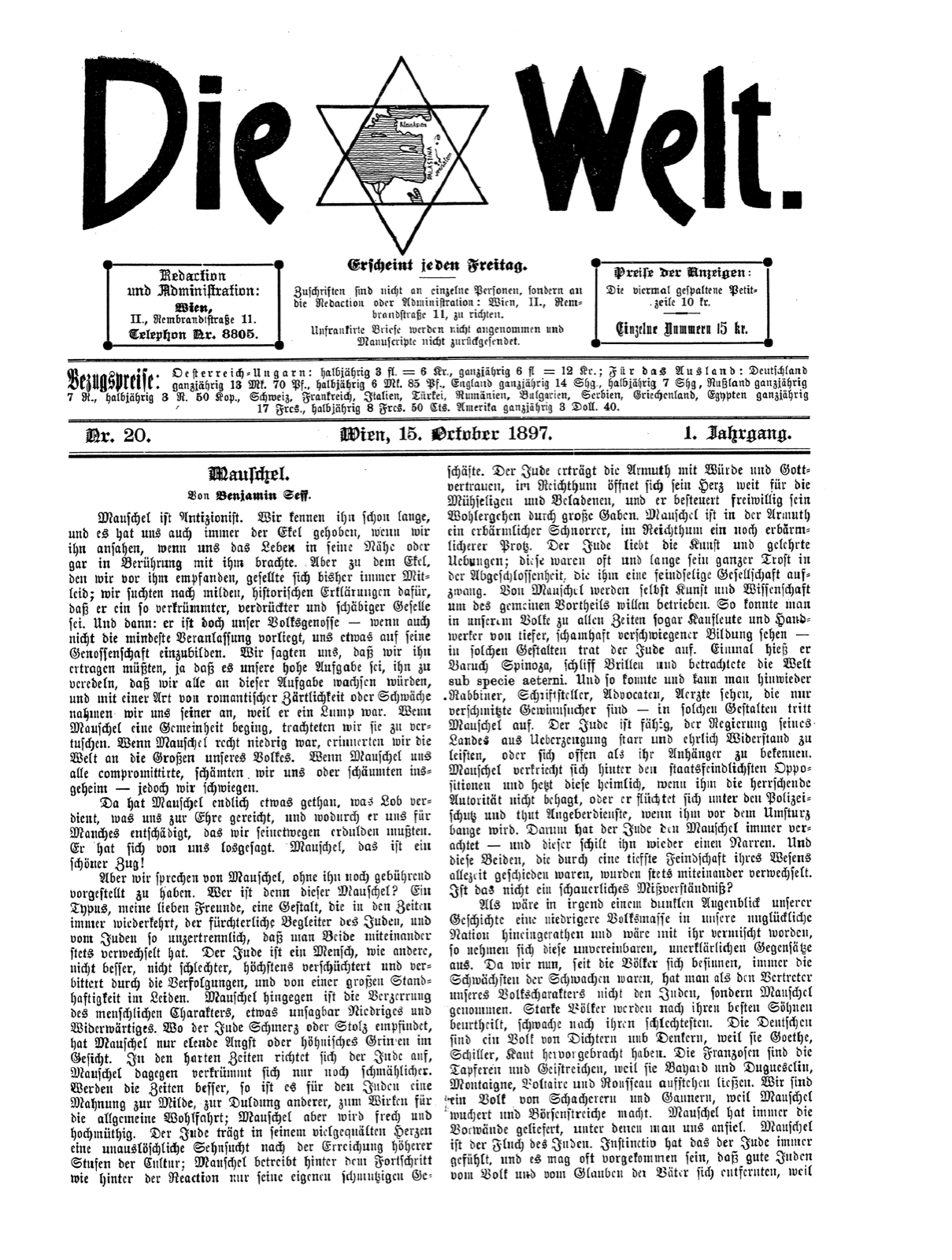
Die Welt.
Appears every Friday.
Editorial Office and Administration: Vienna, II., Rembrandtstrasse 11. Telephone No. 8805. — Communications are to be addressed not to individual persons, but to the Editorial Office or the Administration: Vienna, II., Rembrandtstrasse 11. Unfranked letters are not accepted, and manuscripts are not returned. — Advertisement rates: the four-column petit line, 10 kr. Single numbers 15 kr.
Subscription prices: Austria-Hungary: half-yearly 3 fl. = 6 Kr., yearly 6 fl. = 12 Kr.; for abroad: Germany yearly 13 M. 70 Pf., half-yearly 6 M. 85 Pf., England yearly 14 shg., half-yearly 7 shg., Russia yearly 7 R., half-yearly 3 R. 50 kop., Switzerland, France, Italy, Turkey, Roumania, Bulgaria, Servia, Greece, Egypt yearly 17 frcs., half-yearly 8 frcs. 50 cts. America yearly 3 doll. 40.
No. 20. | Vienna, 15 October 1897. | Vol. I.
Mauschel.
By Benjamin Seff.
Mauschel is an anti-Zionist. We have known him a long while, and disgust has always risen in us when we looked at him, when life brought us into his neighbourhood or even into contact with him. But to the disgust we felt for him there was hitherto always joined a certain pity; we searched after mild, historical explanations for his being so warped, so cowering and so shabby a fellow. And besides: he is, after all, one of our own people — even though there is not the slightest occasion for us to plume ourselves upon his fellowship. We told ourselves that we must endure him, nay, that it was our high task to ennoble him, that we should all grow through this task; and with a kind of romantic tenderness — or weakness — we took his part, because he was a scoundrel. When Mauschel committed some baseness, we sought to hush it up. When Mauschel was thoroughly vile, we reminded the world of the great men of our people. When Mauschel compromised us all, we were ashamed, or we secretly seethed — yet we kept silence.
Now at last Mauschel has done something that deserves praise, that redounds to our honour, and by which he makes us amends for much that we have had to suffer on his account. He has renounced us. Mauschel — that is a handsome trait!
But we speak of Mauschel without having yet presented him as is fitting. Who, then, is this Mauschel? A type, my dear friends; a figure that recurs again and again through the ages, the dreadful companion of the Jew, and so inseparable from the Jew that the two have always been confounded with one another. The Jew is a man like others — no better, no worse, at most intimidated and embittered by the persecutions, and of a great steadfastness in suffering. Mauschel, by contrast, is the distortion of the human character, something unspeakably low and repugnant. Where the Jew feels pain or pride, Mauschel has only wretched fear or a jeering grin upon his face. In hard times the Jew draws himself up; Mauschel, on the other hand, only cringes the more ignominiously. When the times grow better, it is for the Jew an admonition to gentleness, to toleration of others, to labour for the general welfare; Mauschel, however, grows insolent and overbearing. The Jew bears in his sorely tormented heart an inextinguishable longing to attain higher stages of culture; Mauschel, behind progress as behind reaction alike, pursues only his own dirty business. The Jew endures poverty with dignity and trust in God; in wealth his heart opens wide to the toiling and the burdened, and he taxes his own well-being freely with great gifts. Mauschel in poverty is a pitiful schnorrer, in wealth a still more pitiful upstart. The Jew loves art and learned pursuits; these were often, and for long, his whole consolation in the seclusion which a hostile society forced upon him. By Mauschel even art and science are carried on for the sake of vulgar advantage. Thus in our people one could in every age see even merchants and craftsmen of a deep, bashfully concealed cultivation — in such figures the Jew came forward. Once he was called Baruch Spinoza, ground lenses, and contemplated the world sub specie aeterni. And so one could, and can, in turn see rabbis, writers, advocates, physicians who are nothing but crafty seekers of gain — in such figures Mauschel comes forward. The Jew is capable of offering the government of his land, out of conviction, a stiff and honest resistance, or of professing himself openly its adherent. Mauschel creeps away behind the most subversive oppositions and secretly nurses them when the ruling authority does not suit him, or he takes shelter under the protection of the police and turns informer when he grows afraid of the overthrow. For this reason the Jew has always despised Mauschel — and Mauschel, in turn, rails at him for a fool. And these two, who were at all times sundered by the deepest enmity of their very natures, have constantly been mistaken for one another. Is that not a ghastly misunderstanding?
It is as though, at some dark moment of our history, a baser mass of people had strayed into our unhappy nation and been mingled with it — so do these irreconcilable, inexplicable opposites appear. And since we have, ever since the nations began to take stock of themselves, always been the weakest of the weak, they have taken as the representative of our national character not the Jew but Mauschel. Strong peoples are judged by their best sons, weak ones by their worst. The Germans are a people of poets and thinkers, because they brought forth Goethe, Schiller, Kant. The French are the valiant and the witty, because they let arise Bayard and Duquesclin, Montaigne, Voltaire and Rousseau. We are a people of hagglers and swindlers, because Mauschel practises usury and plays his tricks on the Bourse. Mauschel has always furnished the pretexts under which we were assailed. Mauschel is the curse of the Jew. The Jew has always felt this instinctively, and it may often have come to pass that good Jews withdrew from their people and from the faith of the fathers, because