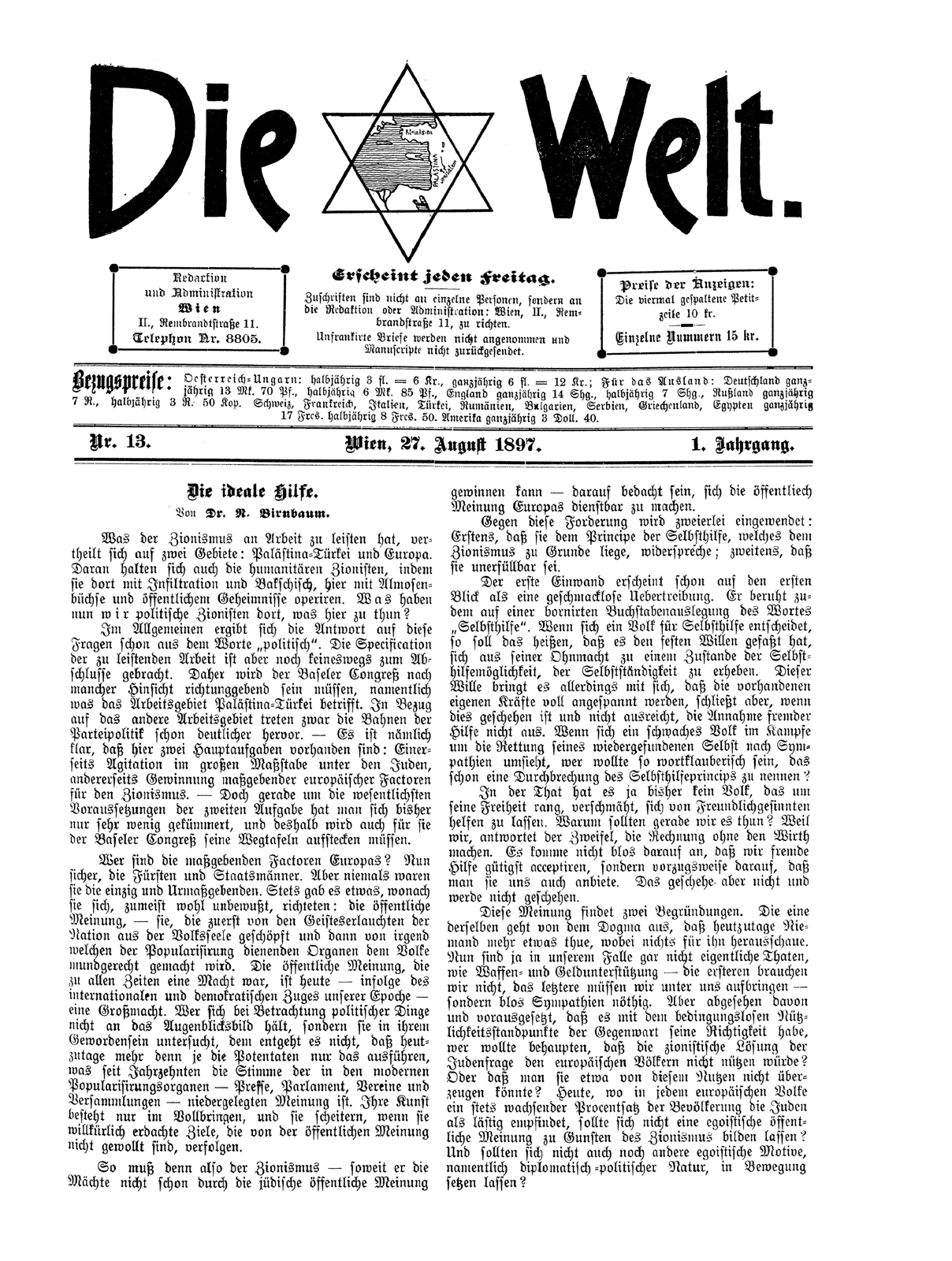
Die Welt.
Editorial Office and Administration VIENNA II., Rembrandtstrasse 11. Telephone No. 8805.
Appears every Friday.
Communications are to be addressed not to individual persons, but to the Editorial Office or the Administration: Vienna, II., Rembrandtstrasse 11.
Unstamped letters will not be accepted, and manuscripts will not be returned.
Advertising Rates: The four-column petit line, 10 kr. Single numbers, 15 kr.
Subscription Rates: Austria-Hungary: half-yearly 3 fl. = 6 Kr., yearly 6 fl. = 12 Kr.; for abroad: Germany yearly 13 Mk. 70 Pf., half-yearly 6 Mk. 85 Pf.; England yearly 14 shg., half-yearly 7 shg.; Russia yearly 7 R., half-yearly 3 R. 50 kop. Switzerland, France, Italy, Turkey, Roumania, Bulgaria, Servia, Greece, Egypt yearly 17 frcs., half-yearly 8 frcs. 50. America yearly 3 doll. 40.
No. 13. Vienna, 27 August 1897. First Year.
The Ideal Help.
By Dr. N. Birnbaum.
The work which Zionism has to perform falls into two fields: Palestine-Turkey and Europe. The humanitarian Zionists likewise keep to these, operating in the one with infiltration and baksheesh, in the other with the alms-box and the open secret. What, then, have we political Zionists to do in the one field, and what in the other?
In general the answer to these questions follows already from the word "political." The specification of the work to be done, however, is by no means yet concluded. The Basle Congress will therefore have to be directive in many respects, particularly as regards the field of labour in Palestine-Turkey. With respect to the other field, the paths of party policy do indeed emerge more distinctly. — For it is clear that here two chief tasks present themselves: on the one hand agitation upon a large scale among the Jews, on the other the winning over of the decisive European factors to Zionism. — Yet precisely with the most essential preconditions of the second task men have hitherto concerned themselves very little, and for that reason the Basle Congress will have to set up its signposts here as well.
Who are the decisive factors of Europe? Certainly the princes and the statesmen. But never were they the sole and original arbiters. There was always something by which they guided themselves, for the most part unconsciously: public opinion — that opinion which is first drawn from the soul of the people by the illumined minds of the nation, and is then made palatable to the people by whatever organs serve the work of popularisation. Public opinion, which has been a power at all times, is to-day — in consequence of the international and democratic tendency of our epoch — a Great Power. Whoever, in considering political matters, does not confine himself to the picture of the moment, but examines them in their becoming, cannot fail to perceive that nowadays more than ever the potentates carry out only that which for decades has been the voice of the opinion deposited in the modern organs of popularisation — press, parliament, associations and assemblies. Their art consists solely in the accomplishing, and they come to grief when they pursue arbitrarily conceived aims which public opinion does not desire.
Thus Zionism must therefore — in so far as it cannot win over the Powers already through Jewish public opinion — be intent upon making the public opinion of Europe serviceable to itself.
Against this demand two objections are raised: first, that it contradicts the principle of self-help which lies at the foundation of Zionism; secondly, that it is incapable of fulfilment.
The first objection appears at the very first glance to be a tasteless exaggeration. It rests moreover upon a narrow-minded literal interpretation of the word "self-help." When a people decides for self-help, this is to mean that it has formed the firm resolve to raise itself out of its impotence to a condition in which self-help is possible, to a condition of independence. This resolve does indeed carry with it that the existing forces of its own be fully exerted, but it does not exclude — when this has been done and does not suffice — the acceptance of help from without. When a weak people, in the struggle for the rescue of its recovered self, looks about it for sympathies, who would be so pettifogging as to call that already a breach of the principle of self-help?
In truth no people that ever wrestled for its freedom has hitherto disdained to let itself be helped by the friendly-minded. Why should we alone do so? Because, answers the doubter, we reckon without our host. It is not merely a question of our graciously accepting foreign help, but above all of its being offered to us. And that, he says, does not happen and will not happen.
This opinion finds two grounds. The one of them proceeds from the dogma that nowadays no one does anything by which nothing is to be gained for himself. Now in our case actual deeds, such as support in arms and in money, are not at all required — the former we do not need, the latter we must raise among ourselves — but merely sympathies. Yet apart from this, and granting that the unconditional standpoint of utility of the present day is correctly stated, who would maintain that the Zionist solution of the Jewish question would not be of use to the European peoples? Or that they could not be convinced of this usefulness? To-day, when in every European people an ever-growing percentage of the population feels the Jews to be burdensome, should it not be possible to form an egoistic public opinion in favour of Zionism? And should it not be possible to set in motion still other egoistic motives, especially of a diplomatic-political nature?