Page 10. — "Die Welt" — No. 11.
(continued from page 9)
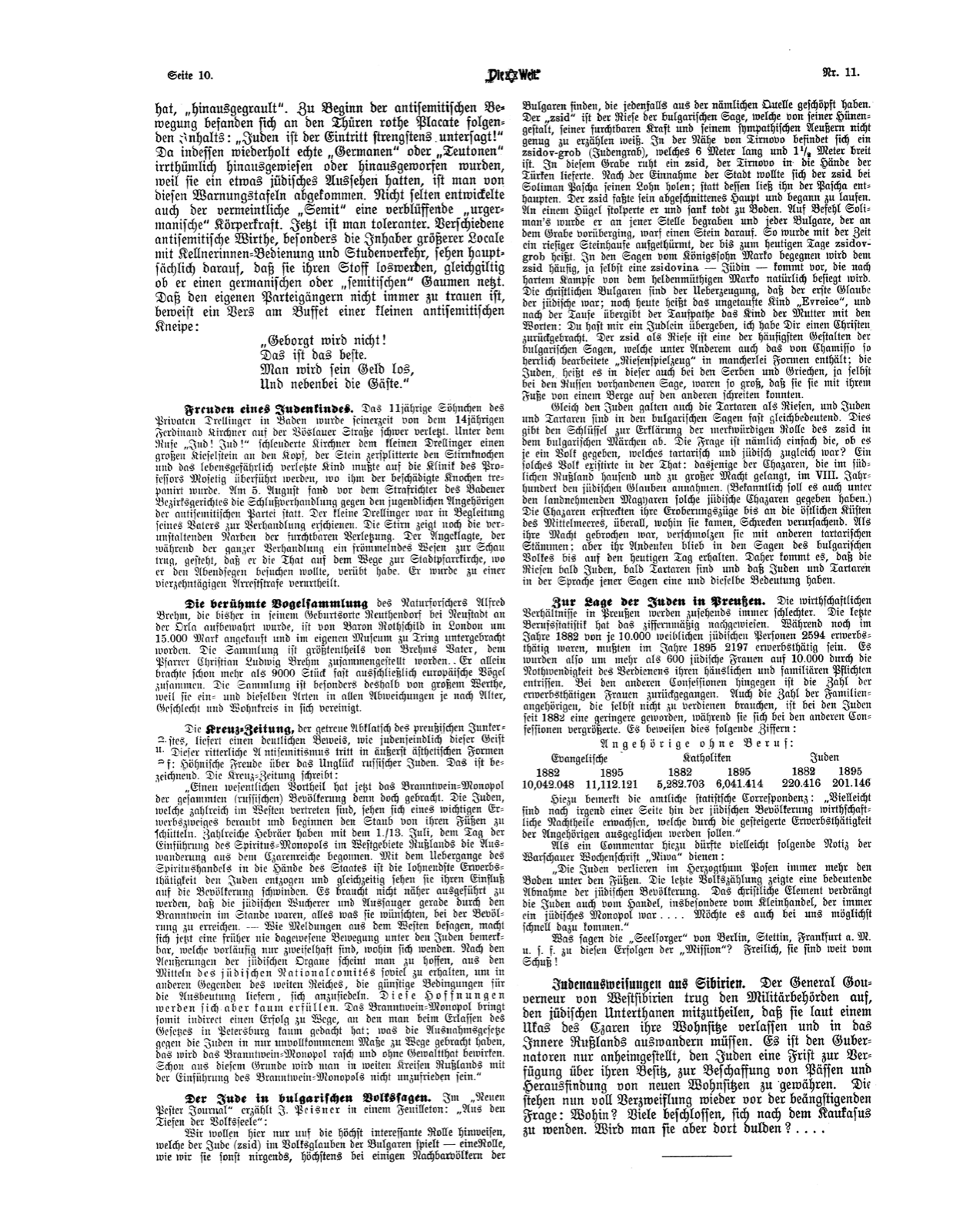
…has, “hounded out.” At the beginning of the anti-Semitic movement there were red placards on the doors with the following text: “Jews are most strictly forbidden to enter!” Since, however, genuine “Germans” or “Teutons” were repeatedly shown or thrown out by mistake, because they had a somewhat Jewish appearance, these warning-boards have been given up. Not seldom, too, the supposed “Semite” developed an astonishing “primitive-Germanic” bodily strength. Nowadays people are more tolerant. Various anti-Semitic publicans, especially the proprietors of larger establishments with waitress service and a student clientele, look chiefly to getting rid of their stock, indifferent whether it moistens a Germanic or a “Semitic” palate. That one's own party-men are not always to be trusted is proved by a verse over the buffet of a small anti-Semitic tavern:
“No credit given! That is the best. A man is rid of his money, And of his guests besides.”
The Joys of a Jewish Child. The eleven-year-old little son of Drellinger, a private gentleman of Baden, was some time ago severely injured by the fourteen-year-old Ferdinand Kirchner in the Vöslauer Straße. With the cry “Jew! Jew!” Kirchner hurled a large pebble at little Drellinger's head; the stone splintered the frontal bone, and the child, whose life was in danger, had to be removed to the clinic of Professor Mojseig, where the damaged bone was trepanned. On the 5th of August the final hearing against the youthful member of the anti-Semitic party took place before the criminal judge of the Baden District Court. Little Drellinger appeared at the hearing in his father's company. His forehead still shows the disfiguring scars of the frightful injury. The accused, who throughout the whole proceedings displayed a sanctimonious demeanour, confesses that he committed the deed on his way to the town parish church, where he intended to attend the evening benediction. He was sentenced to fourteen days' detention.
The famous bird collection of the naturalist Alfred Brehm, hitherto preserved in his birthplace Renthendorf near Neustadt on the Orla, has been purchased by Baron Rothschild in London for 15,000 marks and housed in his own museum at Tring. The collection was for the greater part put together by Brehm's father, the pastor Christian Ludwig Brehm. He alone brought together more than 9000 specimens, almost exclusively European birds. The collection is of great value particularly because it unites one and the same species in all its variations according to age, sex, and habitat.
The Kreuz-Zeitung, the faithful copy of Prussian Junkerdom, furnishes a plain proof how hostile to Jews that spirit is. This chivalrous anti-Semitism appears in exceedingly aesthetic forms: scornful delight at the misfortune of Russian Jews. That is characteristic. The Kreuz-Zeitung writes:
“One essential advantage the brandy monopoly has now brought to the whole (Russian) population after all. The Jews, who are numerously represented in the West, see themselves robbed of an important branch of livelihood and are beginning to shake the dust from their feet. Numerous Hebrews have, with the 1st/13th of July, the day of the introduction of the spirit monopoly in the western territory of Russia, begun their emigration from the Czar's empire. With the passing of the spirit trade into the hands of the State, the most remunerative occupation is withdrawn from the Jews, and at the same time they see their influence upon the population vanishing. It need not be set forth more particularly that it was precisely through brandy that the Jewish usurers and bloodsuckers were in a position to obtain from the population everything they wished. — As reports from the West state, there is now noticeable among the Jews a movement such as never existed before, they being for the present only in doubt whither to turn. From the utterances of the Jewish organs it appears that they hope to receive from the funds of the Jewish National Committee enough to settle in other regions of the vast empire which offer favourable conditions for exploitation. These hopes, however, will hardly be fulfilled. The brandy monopoly thus indirectly brings about a success of which, when the law was enacted at St. Petersburg, hardly anyone thought; what the exceptional laws against the Jews accomplished only in an imperfect degree, the brandy monopoly will effect swiftly and without violence. For this reason alone, wide circles in Russia will not be dissatisfied with the introduction of the brandy monopoly.”
The Jew in Bulgarian Folk-Legends. In the “Neues Pester Journal” J. Peisner relates, in a feuilleton “From the Depths of the Folk-Soul”:
We wish here only to point to the highly interesting part which the Jew (zsid) plays in the popular belief of the Bulgarians — a part such as we find nowhere else, at most among a few neighbouring peoples of the Bulgarians, who have in any case drawn from the same source. The “zsid” is the giant of Bulgarian legend, which can never tell enough of his gigantic stature, his terrible strength, and his sympathetic outward appearance. In the neighbourhood of Tirnovo there is a zsidov-grob (Jew's grave), which is 6 metres long and 1½ metres broad. In this grave rests a zsid who delivered Tirnovo into the hands of the Turks. After the taking of the town the zsid wished to fetch his reward from Soliman Pasha; instead of this the Pasha had him beheaded. The zsid seized his severed head and began to run. At a hillock he stumbled and sank dead to the ground. By Soliman's command he was buried on that spot, and every Bulgarian who passed by the grave threw a stone upon it. Thus in time a huge heap of stones was piled up, which to this day is called zsidov-grob. In the legends of the King's son Marko we meet the zsid frequently; nay, even a zsidovina — a Jewess — occurs, who after a hard struggle is of course vanquished by the heroic Marko. The Christian Bulgarians are convinced that the first faith was the Jewish; to this day the unbaptised child is called “Evreice,” and after the baptism the godfather hands the child to the mother with the words: Thou hast given me a little Jew, I have brought thee back a Christian. The zsid as giant is one of the commonest figures of Bulgarian legend, which among other things also contains in various forms the “Giant's Plaything” so splendidly worked up by Chamisso; the Jews, it is said in this legend, which exists also among the Servians and Greeks, nay even among the Russians, were so large that they could stride with their foot from one mountain to another.
Like the Jews, the Tartars also passed for giants, and Jews and Tartars are in the Bulgarian legends almost synonymous. This gives the key to the explanation of the remarkable part of the zsid in the Bulgarian tale. The question is simply this, whether there was ever a people that was Tartar and Jewish at once? Such a people did in fact exist: that of the Chazars, who, dwelling in southern Russia and attaining to great power, adopted the Jewish faith in the eighth century. (As is well known, such Jewish Chazars are said to have existed also among the land-taking Magyars.) The Chazars extended their campaigns of conquest as far as the eastern coasts of the Mediterranean, causing terror everywhere they came. When their power was broken they were merged with other Tartar tribes; but their memory has been preserved in the legends of the Bulgarian people to the present day. Hence it comes that the giants are now Jews, now Tartars, and that Jews and Tartars have in the language of those legends one and the same meaning.
On the Condition of the Jews in Prussia. The economic conditions in Prussia are growing visibly worse and worse. The last occupational census has demonstrated this in figures. Whereas in the year 1882 out of every 10,000 female Jewish persons 2594 were gainfully employed, in the year 1895 2197 were obliged to be gainfully employed. More than 600 Jewish women in every 10,000 were therefore torn from their domestic and family duties by the necessity of earning. Among the other confessions, on the contrary, the number of gainfully employed women has declined. The number of family members who have no need to earn for themselves has likewise become smaller among the Jews since 1882, while among the other confessions it has increased. The following figures prove this:
Members without an occupation:
| Protestants | Catholics | Jews | |||
|---|---|---|---|---|---|
| 1882 | 1895 | 1882 | 1895 | 1882 | 1895 |
| 10,042.048 | 11,112.121 | 5,282.703 | 6,041.414 | 220.416 | 201.146 |
Upon this the official Statistical Correspondence remarks: “Perhaps economic disadvantages have arisen for the Jewish population in some direction or other, which are to be made good by the increased gainful activity of the family members.”
As a commentary upon this the following note of the Warsaw weekly “Niwa” may perhaps serve:
“The Jews are losing the ground under their feet more and more in the Duchy of Posen. The last census showed a considerable decrease of the Jewish population. The Christian element is displacing the Jews from trade as well, particularly from the retail trade, which was always a Jewish monopoly . . . . May it come to this among us also as quickly as possible.”
What do the “pastors” of Berlin, Stettin, Frankfort-on-Main, and so forth say to these successes of the “Mission”? To be sure, they are well out of range!
Expulsions of Jews from Siberia. The Governor-General of Western Siberia has instructed the military authorities to inform the Jewish subjects that, according to an ukase of the Czar, they must leave their places of residence and emigrate into the interior of Russia. It is left to the governors merely to grant the Jews a term for disposing of their property, for procuring passports, and for finding out new places of residence. These now stand once more, full of despair, before the alarming question: Whither? Many have resolved to turn towards the Caucasus. But will they be tolerated there? . . . .