Page 8. — "Die Welt" — No. 9.
(continued from page 7)
… asked that this too be published, adding: „Thus does Turkey honour the true patriot.“ At his invitation we attended the Selamlik, that magnificent military spectacle.
We were obliged to remain eight days in Constantinople, since before our departure from Larissa we had pledged our word of honour to stay so long in Constantinople as to be able to return at once upon telegraphic notice. This telegram did not arrive, and, having been granted leave by the Minister of War, we were able to set out for home.
A Roumanian vessel carried us, after a glorious passage through the Bosphorus and the Black Sea, to Constanza, whence we travelled by way of Bucharest to Vienna.
J. Schalit.
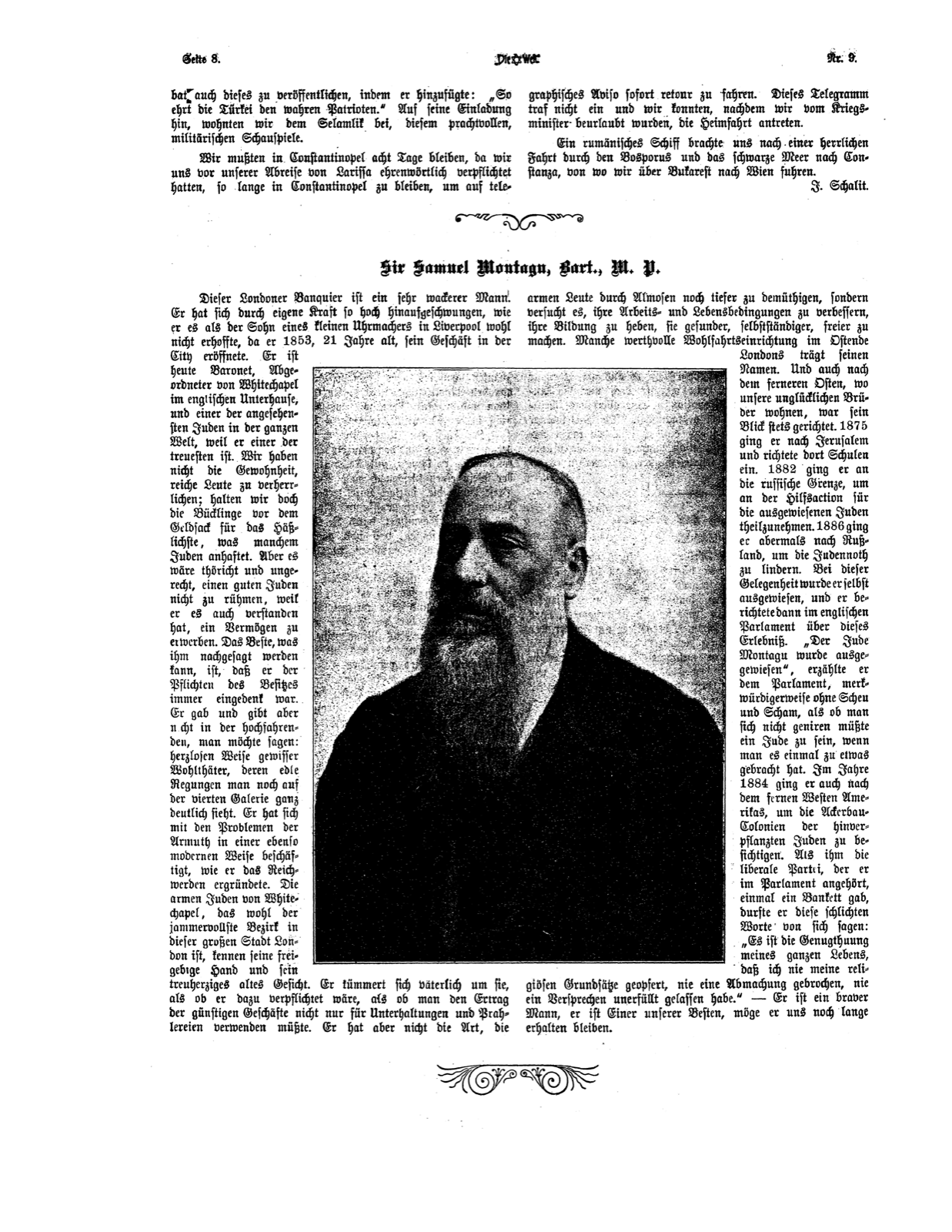
Sir Samuel Montagu, Bart., M. P.
This London banker is a very worthy man. By his own strength he has raised himself as high as he could scarcely have hoped, being the son of a small watchmaker in Liverpool, when in 1853, at the age of twenty-one, he opened his business in the City. To-day he is a baronet, member for Whitechapel in the English House of Commons, and one of the most respected Jews in all the world, because he is one of the most faithful. It is not our habit to glorify rich men; indeed, we hold bowing and scraping before the money-bag to be the ugliest thing that clings to many a Jew. But it would be foolish and unjust not to praise a good Jew merely because he has also known how to acquire a fortune. The best that can be said of him is that he was always mindful of the duties of possession. Yet he gave, and gives, not in the overbearing — one might say heartless — manner of certain benefactors, whose noble impulses may still be seen quite plainly from the fourth gallery. He has concerned himself with the problems of poverty in as modern a fashion as he fathomed the getting of riches. The poor Jews of Whitechapel, which is surely the most wretched district in this great city of London, know his open hand and his honest old face. He cares for them like a father, as though he were bound to do so, as though the proceeds of prosperous business were not to be spent solely upon amusements and ostentation. But it is not his way to humble poor people yet further by alms; rather he seeks to better their conditions of work and of life, to raise their education, to make them healthier, more independent, more free. Many a valuable charitable institution in the East End of London bears his name. And towards the farther East as well, where our unhappy brethren dwell, his gaze was ever directed. In 1875 he went to Jerusalem and established schools there. In 1882 he went to the Russian frontier to take part in the relief work for the expelled Jews. In 1886 he went once more to Russia to alleviate the distress of the Jews. Upon that occasion he was himself expelled, and he afterwards reported this experience in the English Parliament. „The Jew Montagu was expelled,“ he told Parliament — remarkably, without diffidence or shame, as though one need feel no embarrassment at being a Jew once one has made something of oneself. In the year 1884 he went also to the far West of America, to inspect the agricultural colonies of the transplanted Jews. When the Liberal party, to which he belongs in Parliament, once gave him a banquet, he was entitled to say these plain words of himself: „It is the satisfaction of my whole life that I have never sacrificed my religious principles, never broken an agreement, never left a promise unfulfilled.“ — He is a worthy man, he is one of our best; may he long be spared to us.