Page 8. — "Die Welt" — No. 5.
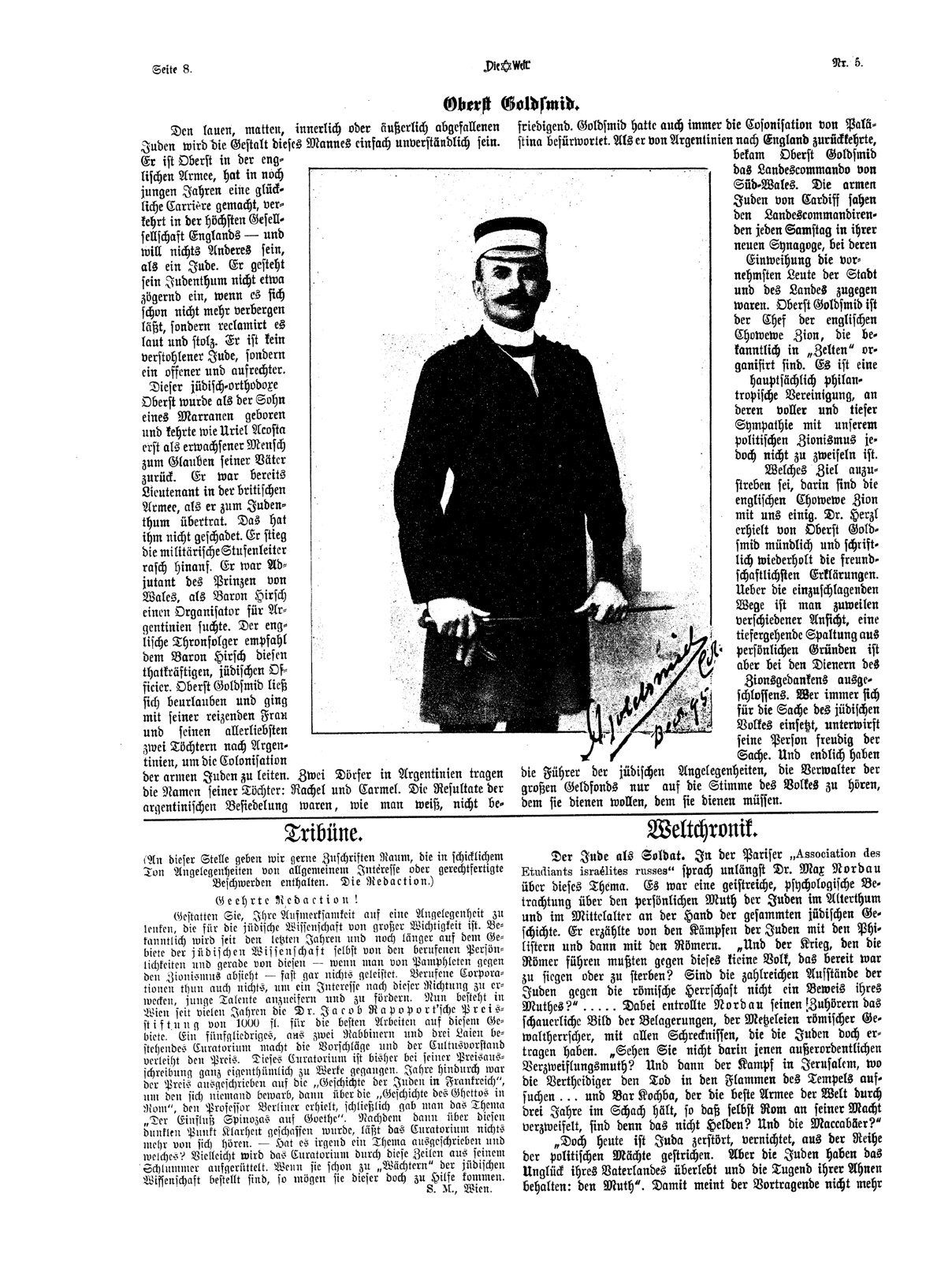
Colonel Goldsmid.
To the lukewarm, the languid, the Jews who have fallen away inwardly or outwardly, the figure of this man will simply be unintelligible. He is a colonel in the English army, has made a fortunate career while still young, moves in the highest society of England — and wishes to be nothing other than a Jew. He does not confess his Jewishness hesitantly, once it can no longer be concealed, but proclaims it aloud and with pride. He is no secretive Jew, but an open and upright one.
This Jewish-orthodox colonel was born the son of a Marrano and, like Uriel Acosta, returned to the faith of his fathers only as a grown man. He was already a lieutenant in the British army when he went over to Judaism. It did him no harm. He mounted the military ladder rapidly. He was aide-de-camp to the Prince of Wales when Baron Hirsch was seeking an organiser for Argentina. The heir to the English throne recommended this energetic Jewish officer to Baron Hirsch. Colonel Goldsmid took leave of absence and went with his charming wife and his two delightful daughters to Argentina, to direct the colonisation of the poor Jews. Two villages in Argentina bear the names of his daughters: Rachel and Carmel. The results of the Argentine settlement were, as is known, not satisfactory. Goldsmid had also always advocated the colonisation of Palestine. When he returned from Argentina to England, Colonel Goldsmid received the district command of South Wales. The poor Jews of Cardiff saw the district commander every Saturday in their new synagogue, at whose consecration the most distinguished people of the town and of the country were present. Colonel Goldsmid is the chief of the English Chowewe Zion, who are, as is well known, organised in "Tents." It is a chiefly philanthropic association, of whose full and deep sympathy with our political Zionism there can, however, be no doubt.
As to what goal is to be striven for, the English Chowewe Zion are at one with us. Dr. Herzl has repeatedly received from Colonel Goldsmid, by word of mouth and in writing, the most friendly declarations. Concerning the paths to be taken, opinions are at times divided, but a deeper split on personal grounds is out of the question among the servants of the Zionist idea. Whoever devotes himself to the cause of the Jewish people gladly subordinates his person to the cause. And finally, the leaders of Jewish affairs, the administrators of the great money funds, have only to listen to the voice of the people whom they wish to serve, whom they must serve.
Tribune.
(In this place we gladly give room to communications which, in a becoming tone, treat matters of general interest or contain justified complaints. The Editors.)
Esteemed Editors!
Permit me to direct your attention to a matter of great importance for Jewish scholarship. It is well known that for some years past, and longer still, almost nothing has been accomplished in the field of Jewish scholarship, even — and precisely — by those persons called to it, if one leaves aside pamphlets against Zionism. Corporations appointed to the task likewise do nothing to awaken an interest in this direction, to spur on and further young talents. Now there has existed in Vienna for many years the Dr. Jacob Rapoport Prize Foundation of 1000 fl. for the best works in this field. A board of five, consisting of two rabbis and three laymen, makes the proposals, and the Board of the Congregation awards the prize. This board of trustees has hitherto proceeded in a most peculiar fashion in its announcement of the prize. For years the prize was announced for the "History of the Jews in France," for which no one competed; then for the "History of the Ghetto in Rome," which Professor Berliner received; finally the theme given was "The Influence of Spinoza upon Goethe." After light had thus been shed upon that obscure point, the board of trustees lets nothing further be heard of it. — Has it announced any theme at all, and which? Perhaps these lines will rouse the board of trustees from its slumber. If they are once appointed "watchmen" of Jewish scholarship, then let them come to its aid.
S. M., Vienna.
World Chronicle.
The Jew as Soldier. In the Parisian "Association des Etudiants israélites russes" Dr. Max Nordau lately spoke upon this theme. It was an ingenious psychological consideration of the personal courage of the Jews in antiquity and in the Middle Ages, drawn from the whole of Jewish history. He told of the struggles of the Jews with the Philistines and then with the Romans. "And the war which the Romans had to wage against this little people, which was ready to conquer or to die? Are not the numerous risings of the Jews against Roman rule a proof of their courage?" . . . . Therewith Nordau unrolled before his hearers the ghastly picture of the sieges, of the massacres of Roman despots, with all the horrors which the Jews nevertheless endured. "Do you not see therein that extraordinary courage of despair? And then the struggle in Jerusalem, where the defenders seek out death in the flames of the Temple . . . and Bar Kochba, who holds the best army in the world in check for three years, so that even Rome despairs of its power — are these then not heroes? And the Maccabees?"
"Yet to-day Judah is destroyed, annihilated, struck from the roll of the political powers. But the Jews have survived the misfortune of their fatherland and have retained the virtue of their forefathers: courage." By this the lecturer means no longer