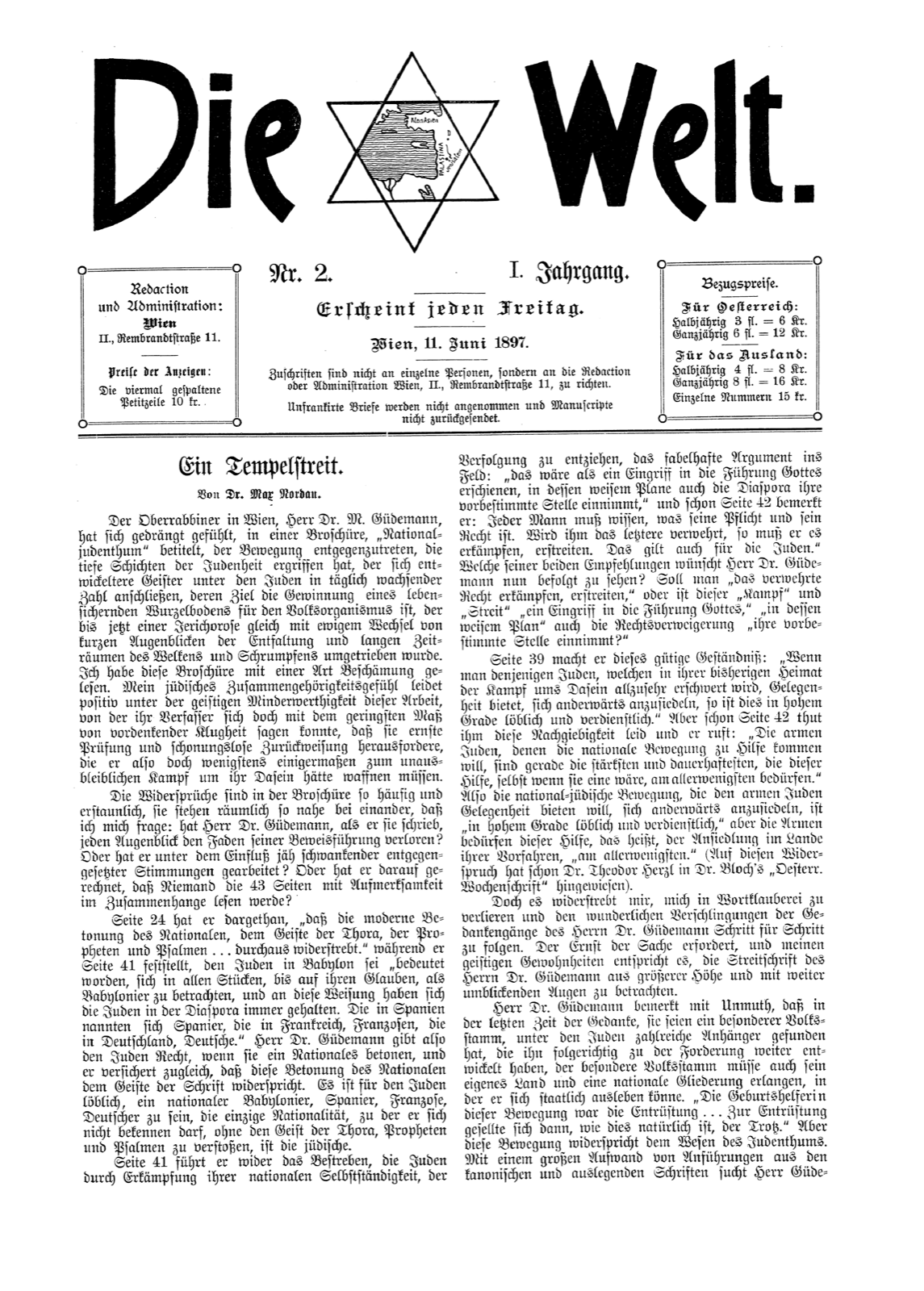
Die Welt.
No. 2.
Vol. I.
Appears every Friday.
Vienna, 11 June 1897.
Editorial Office and Administration: Vienna II., Rembrandtstrasse 11.
Advertising rates: the four-column petit line, 10 kr.
Communications are to be addressed not to individual persons but to the Editorial Office or the Administration, Vienna, II., Rembrandtstrasse 11.
Unstamped letters will not be accepted, and manuscripts will not be returned.
Subscription rates.
For Austria: half-yearly 3 fl. = 6 Kr.; yearly 6 fl. = 12 Kr.
For abroad: half-yearly 4 fl. = 8 Kr.; yearly 8 fl. = 16 Kr. Single numbers 15 kr.
A Temple Quarrel.
By Dr. Max Nordau.
The Chief Rabbi of Vienna, Dr. M. Güdemann, has felt himself impelled to come forward, in a pamphlet entitled "National Judaism," against the movement which has taken hold of the deep strata of Jewry, to which the more developed spirits among the Jews are attaching themselves in daily growing numbers, and whose aim is to win a life-securing root-soil for that national organism which until now has been driven about like a rose of Jericho, in an eternal alternation of brief moments of unfolding and long stretches of withering and shrivelling. I have read this pamphlet with a kind of shame. My Jewish sense of fellowship suffers positively under the intellectual inferiority of this work, of which its author might have told himself, with the smallest measure of forethought, that it would provoke serious examination and unsparing rejection, and which he ought therefore at the very least to have armed in some degree for the inevitable struggle for its existence.
The contradictions in the pamphlet are so frequent and so astonishing, they stand so close together in point of space, that I ask myself: did Dr. Güdemann, while he wrote it, lose the thread of his argument at every moment? Or did he work under the influence of abruptly veering and opposite moods? Or did he count upon it that no one would read the forty-three pages attentively and in their connection?
On page 24 he has set forth "that the modern emphasis upon the national is utterly repugnant to the spirit of the Torah, of the Prophets and of the Psalms," while on page 41 he establishes that the Jews in Babylon were "given to understand that they should regard themselves in all things, save their faith, as Babylonians, and to this instruction the Jews of the Diaspora have always held. Those in Spain called themselves Spaniards; those in France, Frenchmen; those in Germany, Germans." Dr. Güdemann thus allows the Jews to be right when they emphasize something national, and at the same time he assures us that this emphasis upon the national contradicts the spirit of Scripture. It is praiseworthy in the Jew to be a national Babylonian, Spaniard, Frenchman, German; the one nationality he may not profess without offending against the spirit of the Torah, the Prophets and the Psalms is the Jewish.
On page 41 he brings into the field, against the endeavour to withdraw the Jews from persecution by winning their national independence, the fabulous argument: "that would have appeared as an interference with the governance of God, in whose wise plan the Diaspora too occupies its predetermined place"; and already on page 42 he remarks: Every man must know what his duty and his right are. If the latter is denied him, he must win it by fighting, by contending for it. This holds for the Jews as well." Which of his two recommendations does Dr. Güdemann now wish to see followed? Is one to "win the denied right by fighting, by contending for it," or is this "fight" and "contention" "an interference with the governance of God," in "whose wise plan" the denial of right too "occupies its predetermined place"?
On page 39 he makes this gracious confession: "If those Jews for whom the struggle for existence is made all too hard in their hitherto home are offered opportunity to settle elsewhere, this is in a high degree praiseworthy and meritorious." But already on page 42 he repents of this concession and exclaims: "The poor Jews, whom the national movement wishes to come to the aid of, are precisely the strongest and most enduring, who least of all stand in need of this help, even were it help at all." So the national-Jewish movement, which wishes to offer the poor Jews an opportunity to settle elsewhere, is "in a high degree praiseworthy and meritorious," but the poor need this help—that is, settlement in the land of their forefathers—"least of all." (This contradiction has already been pointed out by Dr. Theodor Herzl in Dr. Bloch's "Oesterr. Wochenschrift.")
Yet it goes against me to lose myself in cavilling over words and to follow step by step the singular convolutions of Dr. Güdemann's trains of thought. The seriousness of the matter requires, and it accords with my intellectual habits, that Dr. Güdemann's polemic be considered from a greater height and with eyes that range more widely.
Dr. Güdemann observes with vexation that of late the idea that they are a distinct people has found numerous adherents among the Jews, who have consistently developed it further into the demand that the distinct people must also obtain its own land and a national articulation in which it may live out its life as a state. "The midwife of this movement was indignation ... To indignation there then joined itself, as is natural, defiance." But this movement contradicts the essence of Judaism. With a great expenditure of citations from the canonical and expository writings, Dr. Güde-