— 159 —
11.5 million hl against 13.4 million hl and 10.7 million hl; the islands furnished 6.3 million hl against 4.7 million hl and 6.0 million hl in the two preceding years.
Equally unfavourable was the harvest in Spain. We take from the "Bulletin des Halles, Bourses et Marchés" and the "Moniteur Vinicole" the following on this:
According to the statements of the syndicate of Spanish wine exporters, the wine yield in the year 1903 has been rather weak; it should not exceed 18.46 million hl, while the harvest of 1902 amounted to 23.875 million hl. Even the latter harvest fell behind those of the preceding years, since in 1901 27.676 million hl and in 1900 28.370 million hl were harvested. This constant decline is to be traced back chiefly to the ever-increasing ravages of the phylloxera.
Products whose introduction and development in Palestine is possible.
From the March report, 1904, of the Chemical Works of Julius Grossmann in Hamburg — import and export of drugs, chemicals, dyeing and tanning materials, colonial wares, spices, etc. — we take the prices and manner of packing, reproduced in the following, of products which come into consideration for our territory of colonization in Palestine. The list given below may be regarded, as it were, as a supplement to our Market Report, in which a number of products is already enumerated whose culture is most highly to be recommended to the colonists.
The prices are understood, where not otherwise mentioned, per 100 kg.
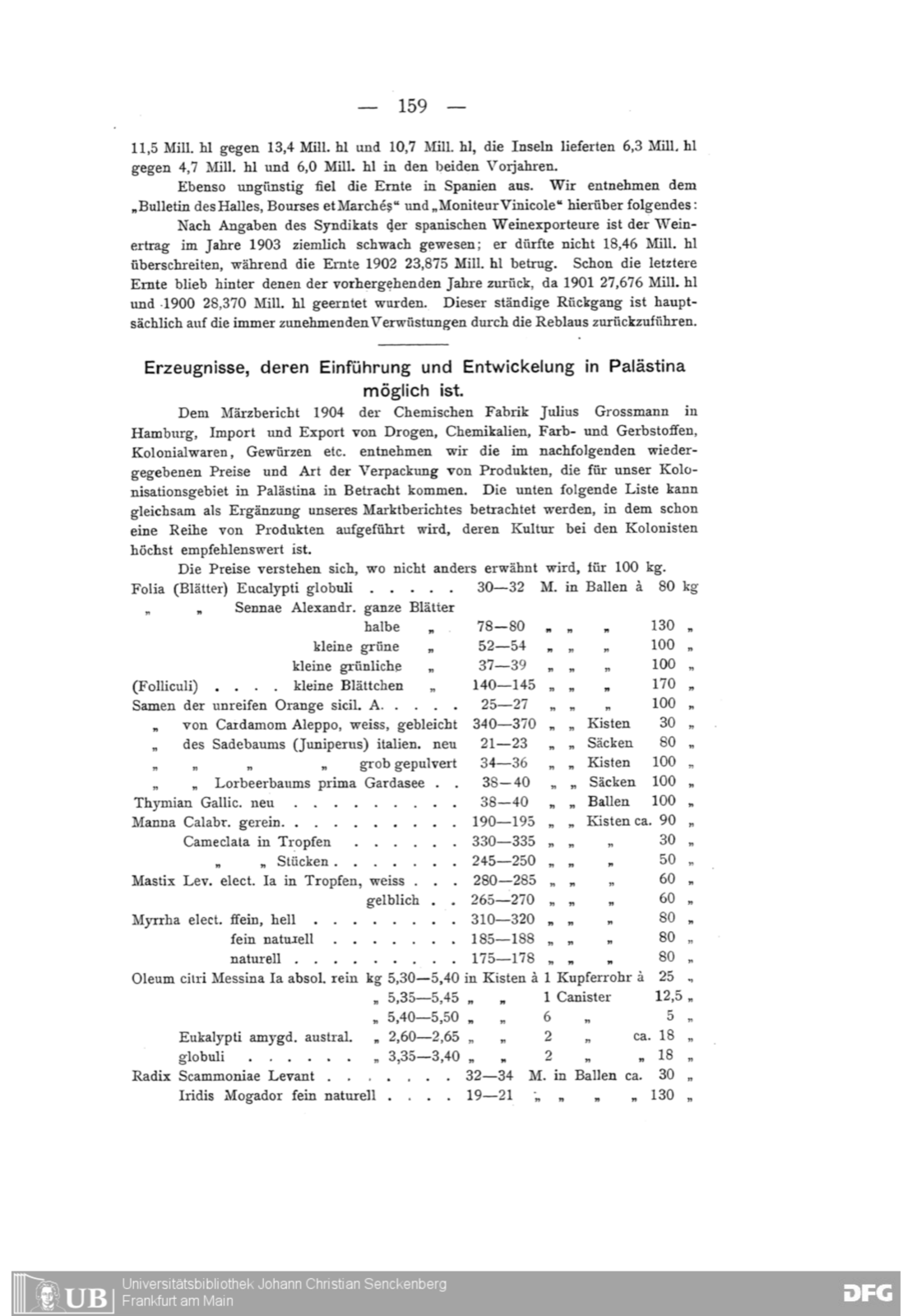
Folia (leaves) Eucalypti globuli . . . . . 30–32 M. in bales of 80 kg " " Sennae Alexandr., whole leaves [Translator's note: no price figures are printed for this line in the original] half " . . 78–80 " " " 130 kg small green " . . 52–54 " " " 100 kg small greenish " . . 37–39 " " " 100 kg (Folliculi) . . . . small leaflets " . . 140–145 " " " 170 kg Seeds of the unripe orange, Sicil. A. . . . . 25–27 " " " 100 kg " of Cardamom, Aleppo, white, bleached 340–370 " " cases 30 kg " of the savin (Juniperus), Italian, new 21–23 " " sacks 80 kg " " " " coarsely powdered 34–36 " " cases 100 kg " of the laurel tree, prima, Lake Garda . . 38–40 " " sacks 100 kg Thyme, Gallic., new . . . . . . . . . 38–40 " " bales 100 kg Manna Calabr., cleaned . . . . . . . . 190–195 " " cases ca. 90 kg Cannelata, in tears . . . . . . 330–335 " " " 30 kg " in pieces . . . . . . . 245–250 " " " 50 kg Mastic Lev. elect. Ia in tears, white . . . 280–285 " " " 60 kg yellowish . . 265–270 " " " 60 kg Myrrh elect., very fine, light . . . . . . 310–320 " " " 80 kg fine natural . . . . . . . 185–188 " " " 80 kg natural . . . . . . . . . 175–178 " " " 80 kg Oleum citri, Messina Ia, absol. pure, kg 5.30–5.40, in cases of 1 copper tube of 25 kg kg 5.35–5.45 " " 1 canister 12.5 kg kg 5.40–5.50 " " 6 " 5 kg Eucalypti amygd., Austral. kg 2.60–2.65 " " 2 " ca. 18 kg globuli . . . . . . kg 3.35–3.40 " " 2 " " 18 kg Radix Scammoniae, Levant . . . . . . 32–34 M. in bales ca. 30 kg Iridis, Mogador, fine natural . . . . 19–21 " " " " 130 kg