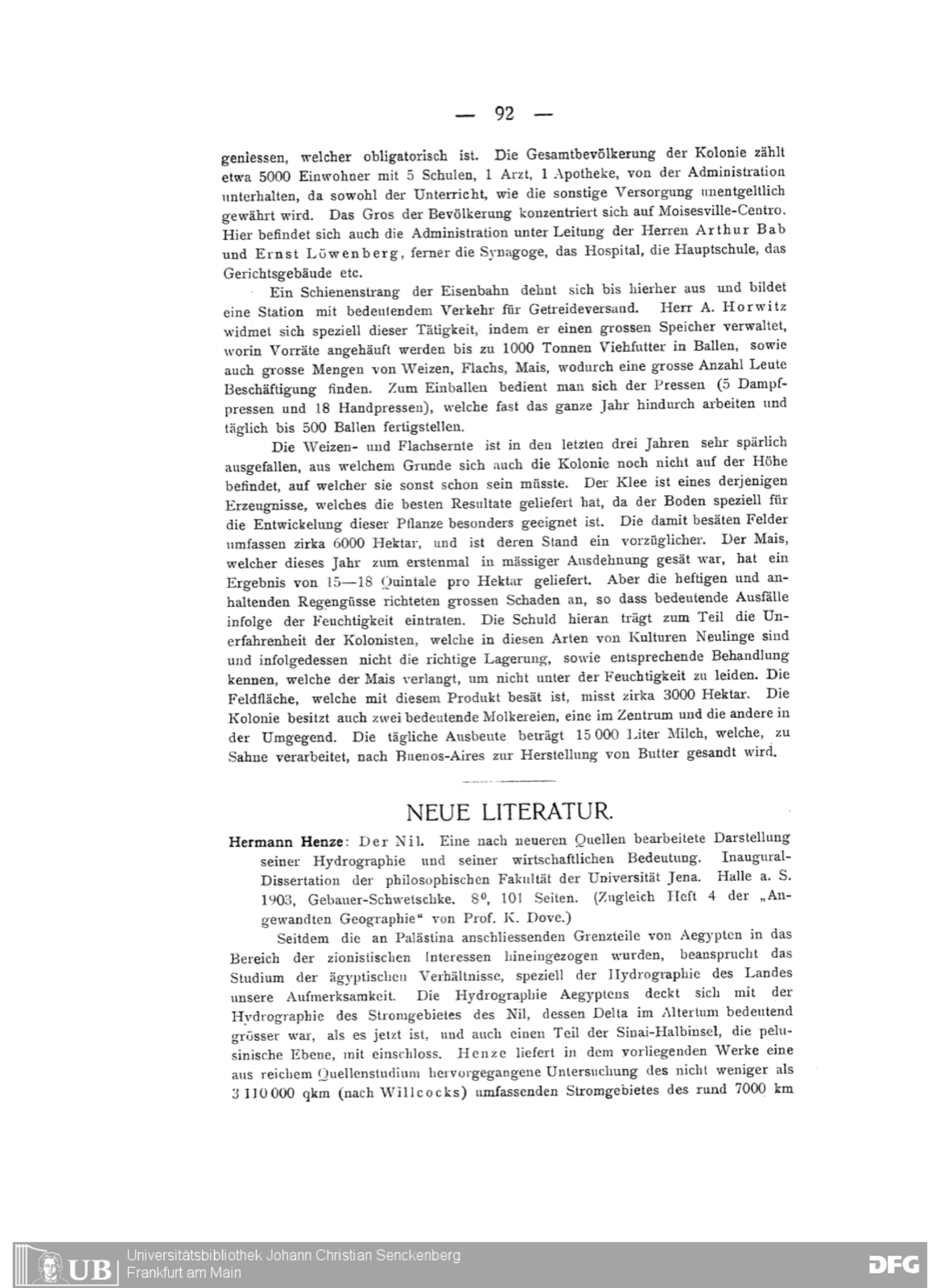
— 92 —
which is obligatory. The total population of the colony numbers about 5000 inhabitants, with 5 schools, 1 physician, 1 apothecary's shop, maintained by the Administration, since the instruction as well as the other provision is granted gratuitously. The bulk of the population is concentrated in Moisesville-Centro. Here is also to be found the Administration under the direction of Messrs. Arthur Bab and Ernst Löwenberg, further the synagogue, the hospital, the principal school, the court-house, etc.
A line of the railway extends as far as here, and forms a station with considerable traffic for the despatch of grain. Mr. A. Horwitz devotes himself specially to this activity, in that he manages a great warehouse in which stores are heaped up of as much as 1000 tons of cattle fodder in bales, as well as great quantities of wheat, flax, and maize, whereby a great number of people find employment. For baling, use is made of presses (5 steam presses and 18 hand presses), which work almost the whole year through and turn out daily up to 500 bales.
The wheat and flax harvest has turned out very scanty in the last three years, for which reason the colony is not yet at the height at which it otherwise ought already to be. Clover is one of those products which have given the best results, since the soil is particularly suited to the development of this plant. The fields sown with it comprise about 6000 hectares, and their condition is excellent. Maize, which this year was sown for the first time on a moderate scale, has given a result of 15–18 quintals per hectare. But the violent and continuous downpours of rain wrought great damage, so that considerable losses occurred in consequence of the moisture. The blame for this is borne in part by the inexperience of the colonists, who are novices in these kinds of cultures and consequently do not know the right storage and the appropriate treatment which maize demands in order not to suffer from moisture. The area of field sown with this product measures about 3000 hectares. The colony possesses also two important dairies, one in the centre and the other in the surrounding district. The daily output amounts to 15,000 litres of milk, which, worked up into cream, is sent to Buenos Aires for the manufacture of butter.
RECENT LITERATURE.
Hermann Henze: Der Nil. A presentation, worked out from recent sources, of its hydrography and its economic importance. Inaugural dissertation of the philosophical faculty of the University of Jena. Halle a. S. 1903, Gebauer-Schwetschke. 8vo, 101 pages. (At the same time Number 4 of the "Angewandte Geographie" of Prof. K. Dove.)
Since the border parts of Egypt adjoining Palestine have been drawn into the range of Zionist interests, the study of Egyptian conditions, especially of the hydrography of the country, claims our attention. The hydrography of Egypt coincides with the hydrography of the river basin of the Nile, whose delta in antiquity was considerably larger than it now is, and also included a part of the Sinai Peninsula, the Pelusian plain. Henze furnishes in the present work an investigation, sprung from a rich study of the sources, of the river basin — comprising no less than 3,110,000 sq. km (according to Willcocks) — of the stream, which is about 7000 km