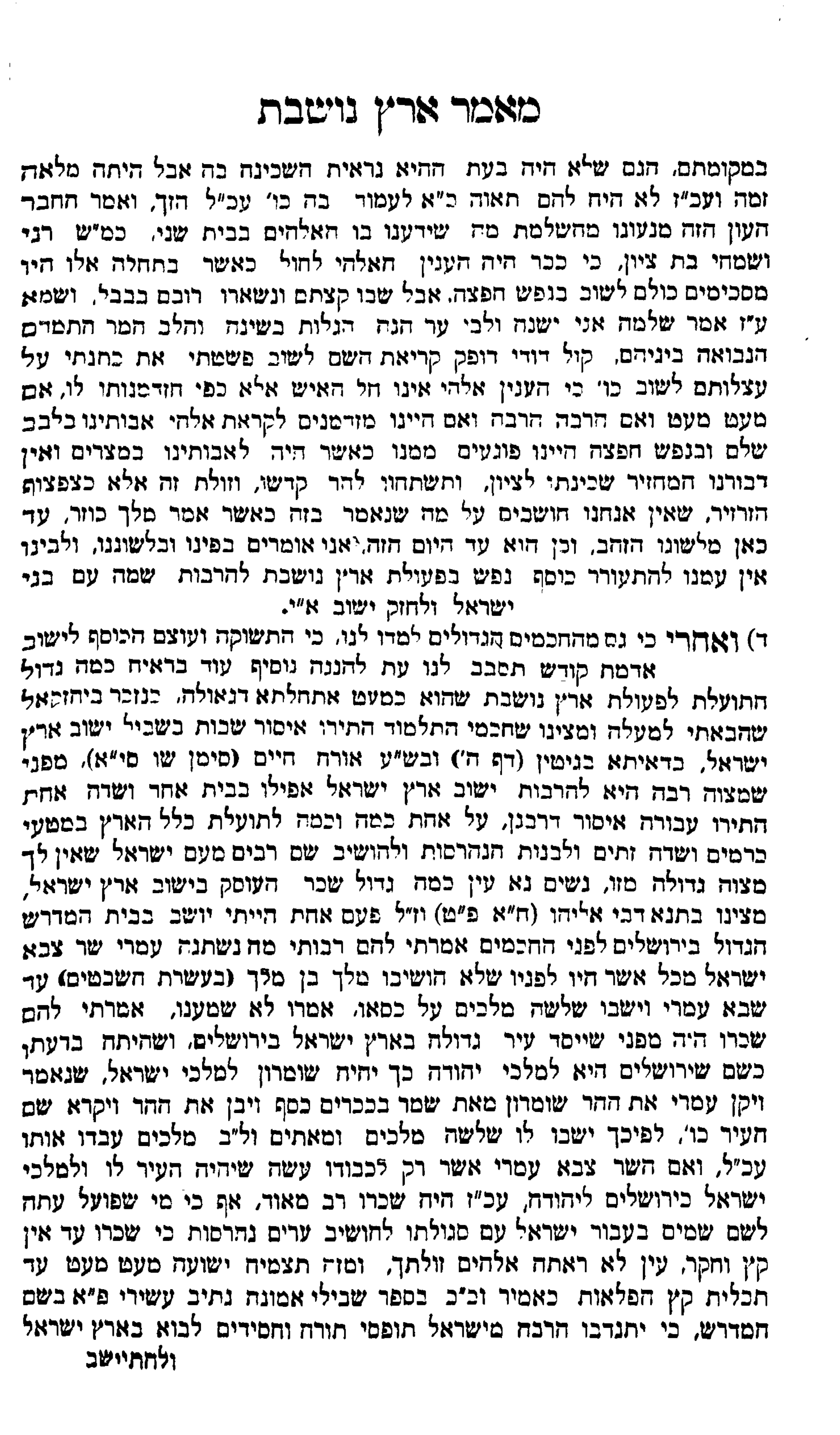
Essay on a Settled Land
…in their own places, even though at that time the Shekhinah was not visible in it, but it was full of lewdness; and nevertheless they had no desire except to stand in it, etc." End of his pure words. And the Haver said: "This iniquity kept us from the completion of what God made known to us concerning it in the Second Temple, as it is said, 'Sing and rejoice, O daughter of Zion'; for the divine influence was already ready to rest as at the first, had they all agreed to return with a willing soul; but some of them returned and the most of them remained in Babylon. And perhaps it was of this that Solomon said, 'I sleep, but my heart wakes': behold, the exile is in sleep, and the bitter heart is their continuance of prophecy among them; 'the voice of my beloved knocks' is the call of Yahweh to return; 'I have put off my coat' is for their sloth to return, etc. For the divine influence rests upon a man only according to his preparedness for it: if little, little, and if much, much. And if we were prepared to go forth to meet the God of our fathers with a whole heart and a willing soul, we would meet with from Him what befell our fathers in Egypt; and our saying 'Who restores my Shekhinah to Zion', and 'Bow down at His holy mountain', and the like, is nothing but as the chirping of the starling, for we give no thought to what is said in it, as the king of the Khazars said." Thus far from his golden words. And so it is to this very day: we say it with our mouth and with our tongue, but our heart is not with us, to awaken the longing of the soul for the work of a settled land, to increase there the people of the children of Israel, and to strengthen the settlement of the Land of Israel.
- And since we have learned from the great sages as well that the desire and the strength of longing for the settlement of the holy soil will bring about for us the time to favour her, we shall add yet further proof of how great is the benefit of the work of a settled land, which is almost the beginning of the redemption, as mentioned in Ezekiel, which I cited above. And we find that the sages of the Talmud permitted a rabbinic Sabbath prohibition for the sake of the settlement of the Land of Israel, as is stated in Gittin (folio 5) and in the Shulhan Arukh, Orah Hayyim (section 306, paragraph 11): because it is a great commandment to increase the settlement of the Land of Israel, even by one house and one field, they permitted a rabbinic prohibition for its sake. How much more so for the benefit of the Land as a whole, in the planting of vineyards and fields of olives, and in building what has been destroyed, and in settling there many of the people of Israel, for there is no greater commandment than this! Let us now give heed to how great is the reward of one who busies himself with the settlement of the Land of Israel. We find in Tanna de-Vei Eliyahu (Part 1, chapter 9), and these are its words: "Once I was sitting in the great house of study in Jerusalem before the sages. I said to them: My masters, how does Omri, captain of the host of Israel, differ from all who were before him, that they did not seat a king son of a king (among the Ten Tribes) until Omri came, and three kings sat upon his throne? They said: We have not heard. I said to them: His reward was because he founded a great city in the Land of Israel, in Jerusalem, and it was in his mind that, just as Jerusalem is for the kings of Judah, so shall Samaria be for the kings of Israel; as it is said, 'And Omri bought the hill Samaria of Shemer for two talents of silver, and he built on the hill, and called the name of the city, etc.' Therefore three kings sat for him, and two hundred and thirty-two kings served him." End of its words. And if Omri, the captain of the host, who did it only for his own honour, so that the city should be his and the kings of Israel's as Jerusalem was Judah's, nevertheless had a very great reward, how much more one who works now for the sake of Heaven, on behalf of Israel His treasured people, to resettle ruined cities: his reward is without end or measure; "no eye has seen, O God, beside thee." And from this salvation will spring forth little by little, until the final End of the wonders, as has been said. And so it is written in the book Shevilei Emunah, the tenth path, chapter 1, in the name of the Midrash, that many of Israel, holders of the Torah and pious men, will offer themselves willingly to come into the Land of Israel