First to Zion 18
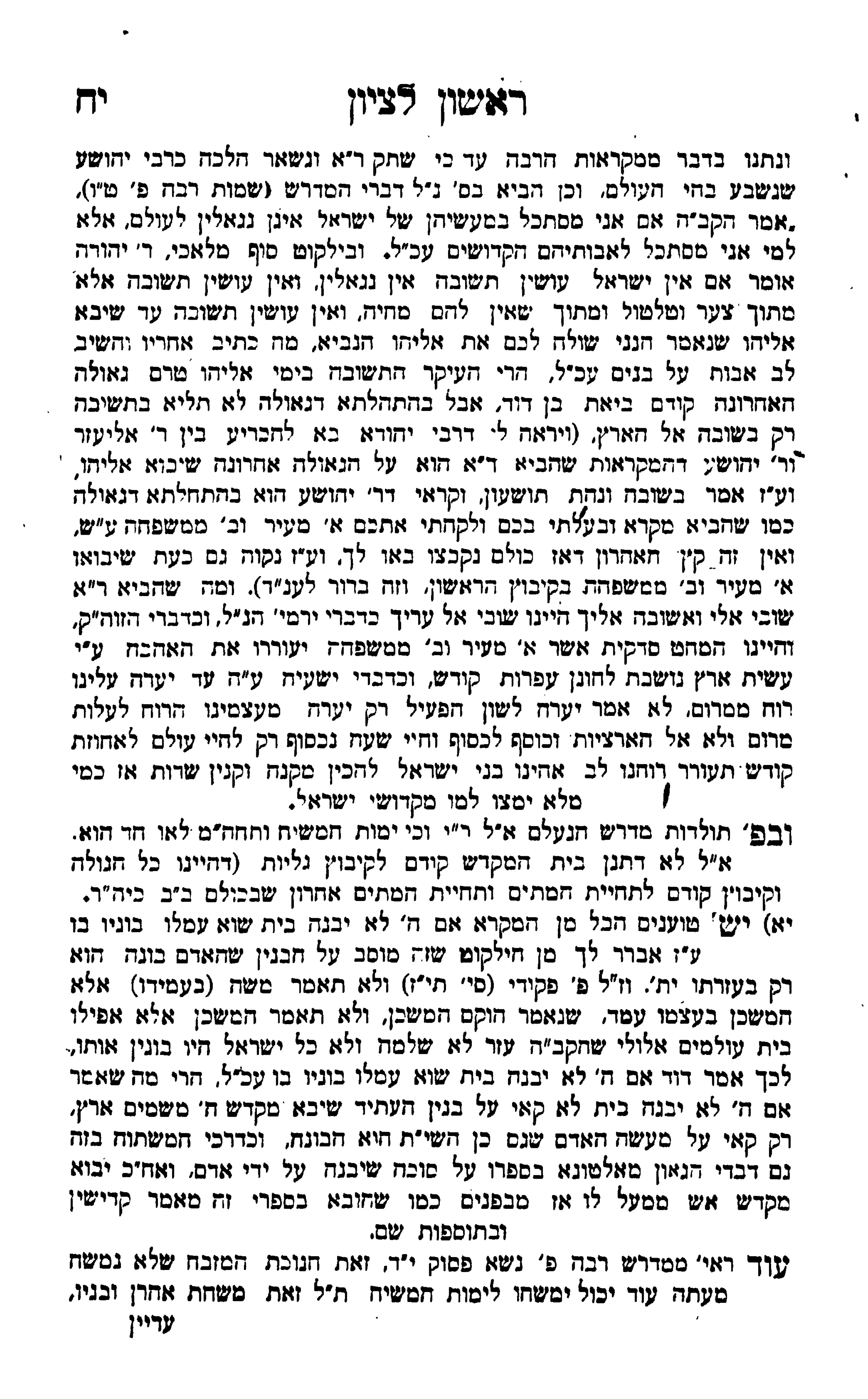
…back and forth on the matter with many verses, until Rabbi Eliezer fell silent, and the halakhah remained according to Rabbi Joshua, who swore by Him that lives for ever. And so the book mentioned above cites the words of the Midrash (Exodus Rabbah, section 15): "The Holy One, blessed be He, said: If I look at the deeds of Israel, they will never be redeemed; but to whom do I look? To their holy fathers." End of its words. And in the Yalkut, at the end of Malachi: Rabbi Judah says, If Israel do not repent they are not redeemed; and they do not repent except out of distress and wandering, and out of having no livelihood; and they do not repent until Elijah comes, as it is said, "Behold, I am sending you Elijah the prophet"; what is written after it? "And he shall bring back the heart of the fathers to the sons." End of its words. Behold, the chief repentance is in the days of Elijah, before the final redemption, before the coming of the son of David; but the beginning of the redemption does not depend on repentance, only on returning to the Land. (And it seems to me that Rabbi Judah comes to decide between Rabbi Eliezer and Rabbi Joshua: the verses that Rabbi Eliezer brought concern the final redemption, when Elijah will come, and of this it said, "By returning and rest you shall be saved"; and the verses of Rabbi Joshua concern the beginning of the redemption, as he brought the verse, "And I will be master over you, and I will take you, one from a city and two from a family", see there; and this is not the final End, for then "all of them are gathered, they come to thee"; and for this we hope even now, that they will come, one from a city and two from a family, in the first ingathering; and this is clear to my humble mind.) And what Rabbi Eliezer brought, "Come back to Me, and I will come back to thee", that is, "come back to thy cities", as in the words of Jeremiah mentioned above, and as in the words of the holy Zohar, that is, the needle's eye, whereby one from a city and two from a family will awaken the love by making a settled land, to show favour to the holy dust; and as in the words of Isaiah, peace be upon him, "until a spirit is poured out upon us from on high": he did not say "pour" in the causative form, but "is poured", from ourselves, the spirit to go up on high and not to earthly things; and a longing to long: and shall we long for the life of the hour? Only for eternal life, for a holy possession. May our spirit awaken the heart of our brethren the children of Israel to prepare cattle and the purchase of fields; then, as waters of fullness, they shall be drained out for them from the holy ones of Israel.
And in the section Toledot, in the Midrash ha-Ne'elam: Rabbi Judah said to him, Are not the days of the Messiah and the resurrection of the dead one and the same? He said to him, No, for we have learnt: the Temple comes before the ingathering of the exiles (that is, the whole exile, and their ingathering comes before the resurrection of the dead, and the resurrection of the dead is the last of them all; speedily in our days, so may it be His will.
- There are some who argue everything from the verse, "If Yahweh does not build the house, its builders have toiled at it in vain." To this I will make clear to you from the Yalkut that this refers to the building that man builds, which is only with His help, blessed be He. And these are its words, section Pekudei (paragraph 417): "And do not say Moses (in his setting it up), but the Tabernacle stood up of itself, as it is said, 'the Tabernacle was set up'; and do not say the Tabernacle only, but even the Everlasting House: had not the Holy One, blessed be He, helped, neither Solomon nor all Israel would have built it. Therefore David said, 'If Yahweh does not build the house, its builders have toiled at it in vain.'" End of its words. Behold, what he said, "If Yahweh does not build the house", does not refer to the future building, when the Sanctuary of Yahweh will come from heaven to earth, but refers to the work of man, of which Yahweh, blessed be He, is likewise the builder. And in agreement with my way in this are also the words of the Gaon of Altona in his book on Sukkah, that it will be built by man, and afterwards the Sanctuary of fire will come from above it or from within it, as is cited in this book of mine, the Essay on Holy Things, and in Tosafot there.
Further, a proof from the Midrash Rabbah, section Naso, verse 14: "This is the dedication of the altar" — that it is not anointed any more from now on. One might think that they will anoint it in the days of the Messiah; Scripture says, "This is the anointing of Aaron and his sons",