Mount Tzvi
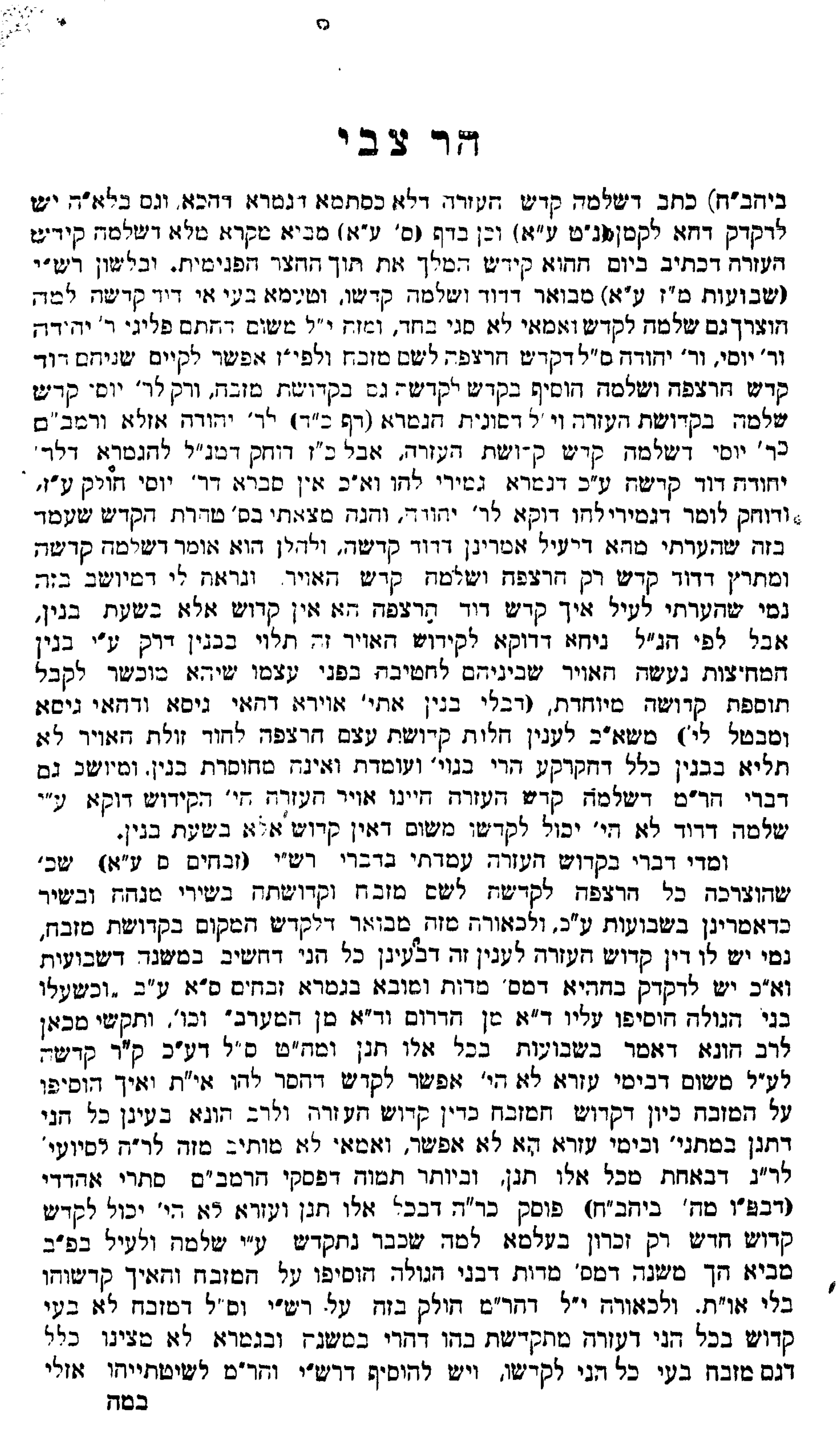
…the Chosen House) wrote that Solomon sanctified the Court, not in accordance with the unattributed statement of the Talmud here. And even without this one must examine it: for below (59a), and likewise on page (60a), it brings an explicit verse that Solomon sanctified the Court, as it is written, "On that day the king sanctified the middle of the inner court." And in the language of Rashi (Shevuot 16a) it is plain that David and Solomon sanctified it; and this requires a reason: if David sanctified it, why did Solomon also need to sanctify it, and why was one not enough? And from this one may say that it is because there Rabbi Judah and Rabbi Yose disagree, and Rabbi Judah holds that he sanctified the pavement for the sake of the altar; and according to this it is possible to uphold both: David sanctified the pavement, and Solomon added in holiness, to sanctify it also with the sanctity of the altar; and only according to Rabbi Yose did Solomon sanctify with the sanctity of the Court. And one may say that the discussion of the Talmud (page 24) goes according to Rabbi Judah, and Maimonides according to Rabbi Yose, that Solomon sanctified with the sanctity of the Court. But all this is forced: for whence does the Talmud know that according to Rabbi Judah David sanctified it? It must be that the Talmud had it as a tradition, and if so there is no reason that Rabbi Yose should dispute this; and it is forced to say that they had it as a tradition only according to Rabbi Judah. And behold, I found in the book Tohorat ha-Kodesh that he took up this point which I noted, that above we say that David sanctified it, and below it says that Solomon sanctified it; and he answers that David sanctified only the pavement, and Solomon sanctified the air. And it seems to me that by this there is also settled what I noted above: how did David sanctify the pavement, since there is sanctification only at the time of building? But according to the above it is well: for only the sanctification of the air depends on building, since only through the building of the partitions does the air between them become a unit by itself, so that it be fit to receive a special addition of sanctity (for without a building the air of this side and of that side comes and annuls it); whereas as regards the taking effect of the sanctity of the pavement itself alone, apart from the air, it does not depend on building at all, for the ground is built and standing and lacks no building. And so the words of Maimonides are also settled, that Solomon sanctified the Court: that is, the sanctification of the air of the Court was specifically through Solomon, for David could not sanctify it, because there is sanctification only at the time of building.
And while I speak of the sanctification of the Court, I considered the words of Rashi (Zevahim 60a), who wrote that "the whole pavement had to be sanctified for the sake of the altar, and its sanctification is with the remainders of the meal-offering and with song, as we say in Shevuot"; thus far. And at first glance it is plain from this that sanctifying the place with the sanctity of the altar also has the law of the sanctification of the Court in this respect, that we require all those that are counted in the Mishnah of Shevuot. And if so, one must examine that passage of tractate Middot, which is brought in the Talmud, Zevahim 61b: "And when the children of the Exile came up, they added to it four cubits on the south and four cubits on the west", etc. And from here there would be a difficulty against Rav Huna, who says in Shevuot, "With all of these we learned", and for this reason holds that the first sanctity necessarily sanctified for the time to come, because in the days of Ezra it was not possible to sanctify, since they lacked the Urim and Thummim. And how did they add to the altar, since the sanctification of the altar is like the law of the sanctification of the Court, and according to Rav Huna we require all those that we learned in the Mishnah, and in the days of Ezra that was surely not possible? And why does he not raise a difficulty from this against Rav Huna, in support of Rav Nahman, who says, "With one of all these we learned"? And more astonishing still, the rulings of Maimonides contradict each other: (for in chapter 6 of the Laws of the Chosen House) he rules like Rav Huna, that "with all of these we learned", and that Ezra could not sanctify a new sanctification, but only a mere remembrance of what had already been sanctified by Solomon; and above, in chapter 2, he brings this mishnah of tractate Middot, that the children of the Exile added to the altar. And how did they sanctify it without the Urim and Thummim? And at first glance one may say that Maimonides disagrees in this with Rashi, and holds that the altar does not require sanctification with all those by which the Court is sanctified, for in the Mishnah and in the Talmud we do not find at all that the altar too requires all these to sanctify it. And one may add that Rashi and Maimonides follow their own views