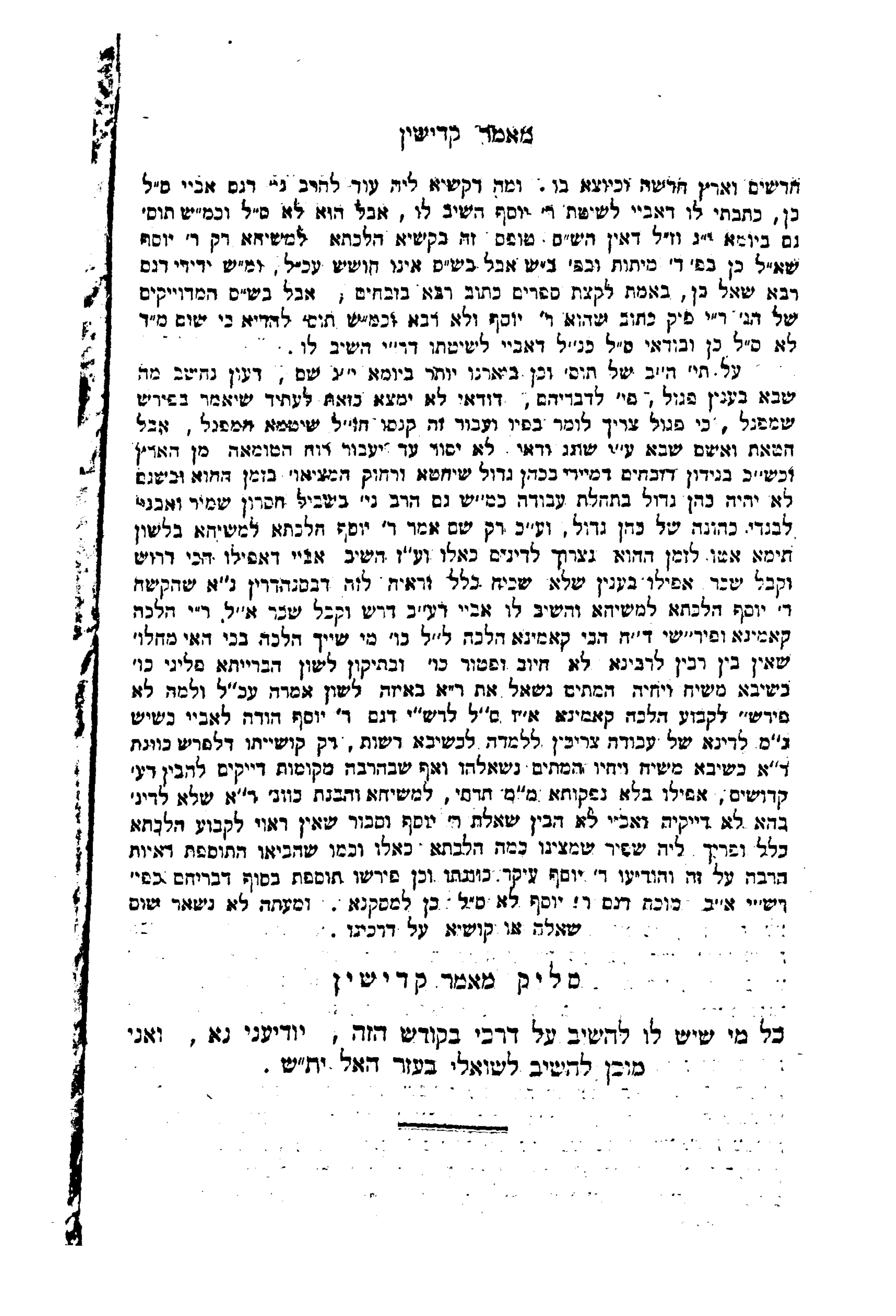
Essay on Holy Things
…new, and a new earth, and the like. And as to what further troubled the Rabbi, may his light shine, that Abaye too holds so, I wrote to him that Abaye answered him according to the method of Rav Joseph, but he himself does not hold so; and as Tosafot also wrote in Yoma 13, and this is their language: "For the Talmud does not adopt this form of objection, 'a halakhah for the Messiah', except Rav Joseph, who said so in the chapter Four Deaths and in the chapter Beit Shammai; but the Talmud is not concerned with it", end of their language. And as for what my friend wrote, that Rava too asked so: in truth, in some books "Rava" is written in Zevahim; but in the accurate Talmud editions of the Gaon Rabbi Isaiah Pick it is written that it is Rav Joseph and not Rava, and as Tosafot wrote explicitly, that no one who speaks holds so; and certainly he holds as above, that Abaye answered him according to the method of Rav Joseph.
On the second answer of Tosafot, as we explained further in Yoma 13 there: that what is reckoned a sin is that which comes in the matter of piggul. The explanation of their words: that certainly such a thing will not be found in the future, that one should say explicitly that he renders it piggul; for piggul must be spoken with the mouth, and on account of this our Sages of blessed memory imposed a penalty, that the one who renders it piggul should become impure. But a sin-offering and a guilt-offering, which come through inadvertence, certainly will not cease until the spirit of impurity passes from the earth. And all the more so in the case at issue in Zevahim, which speaks of a High Priest who sins, and that is a remote eventuality at that time; and the more so since there will be no High Priest at the beginning of the Service, as the Rabbi, may his light shine, also wrote, for want of the shamir and of the stones for the priestly garments of the High Priest. And therefore only there did Rav Joseph say "a halakhah for the Messiah", in a tone of wonder: will we, then, at that time need such laws? And to this Abaye replied that even so, "expound and receive reward", even in a matter that does not occur at all. And the proof of this: in Sanhedrin 51, where Rav Joseph objected "a halakhah for the Messiah!", and Abaye replied to him that perforce "expound and receive reward", Rav Joseph said to him: "I am speaking of a halakhah." And Rashi explained, on the passage beginning "This is what I am saying": "Why do I need a halakhah? etc. Does a halakhah apply to such a dispute, where between Ravin and Ravina there is neither liability nor exemption, etc., and they dispute over the correction of the wording of the baraita, etc.? When the Messiah comes and revives the dead, we shall ask Rabbi Eliezer in which wording he said it", end of his language. And why did Rashi not explain "I am speaking of fixing the halakhah"? It must be that Rashi holds that Rav Joseph too conceded to Abaye that where there is a practical difference for the law of the Service, one must learn it for when permission comes; only his difficulty was that, as for explaining the intention of Rabbi Eliezer, when the Messiah comes and the dead revive we shall ask him. And although in many places they are exact in understanding the opinions of the holy ones even without a practical consequence, nevertheless two things together, "for the Messiah" and the understanding of Rabbi Eliezer's intention not for the sake of law, in this one is not exact. For Abaye did not understand Rav Joseph's question and supposed that it is not proper to fix a halakhah at all, and he rightly objected to him that we find several such halakhot, as Tosafot brought many proofs of this; and Rav Joseph made known to him the essence of his intention. And so Tosafot explained at the end of their words, in explanation of Rashi. If so, it is proven that Rav Joseph too does not hold so in the conclusion. And from now on there remains no question or difficulty about our way.
End of the Essay on Holy Things
Whoever has anything to answer against my way in this holy matter, let him please inform me, and I am ready to answer those who ask me, with the help of God, blessed be His name.