482 It is evident from this that mixed marriages are constantly on the rise. In all of Germany, mixed marriages in 1905 made up 21% of purely Jewish marriages. Bavaria, which can also be considered a prototype for all of Catholic southern Germany, lags (at 10.3%) behind the national average. Prussia (i.e., Protestant northern and central Germany), on the other hand, is (at 23.6%) slightly above the national average. This is significantly exceeded in Berlin and Hamburg, where mixed marriages make up no less than 44.4% and 49.5%, respectively, of purely Jewish marriages.
Almost without exception, the mixed marriages of a Jewish man with a Christian woman are more frequent than the mixed marriage of a Christian man with a Jewish woman.
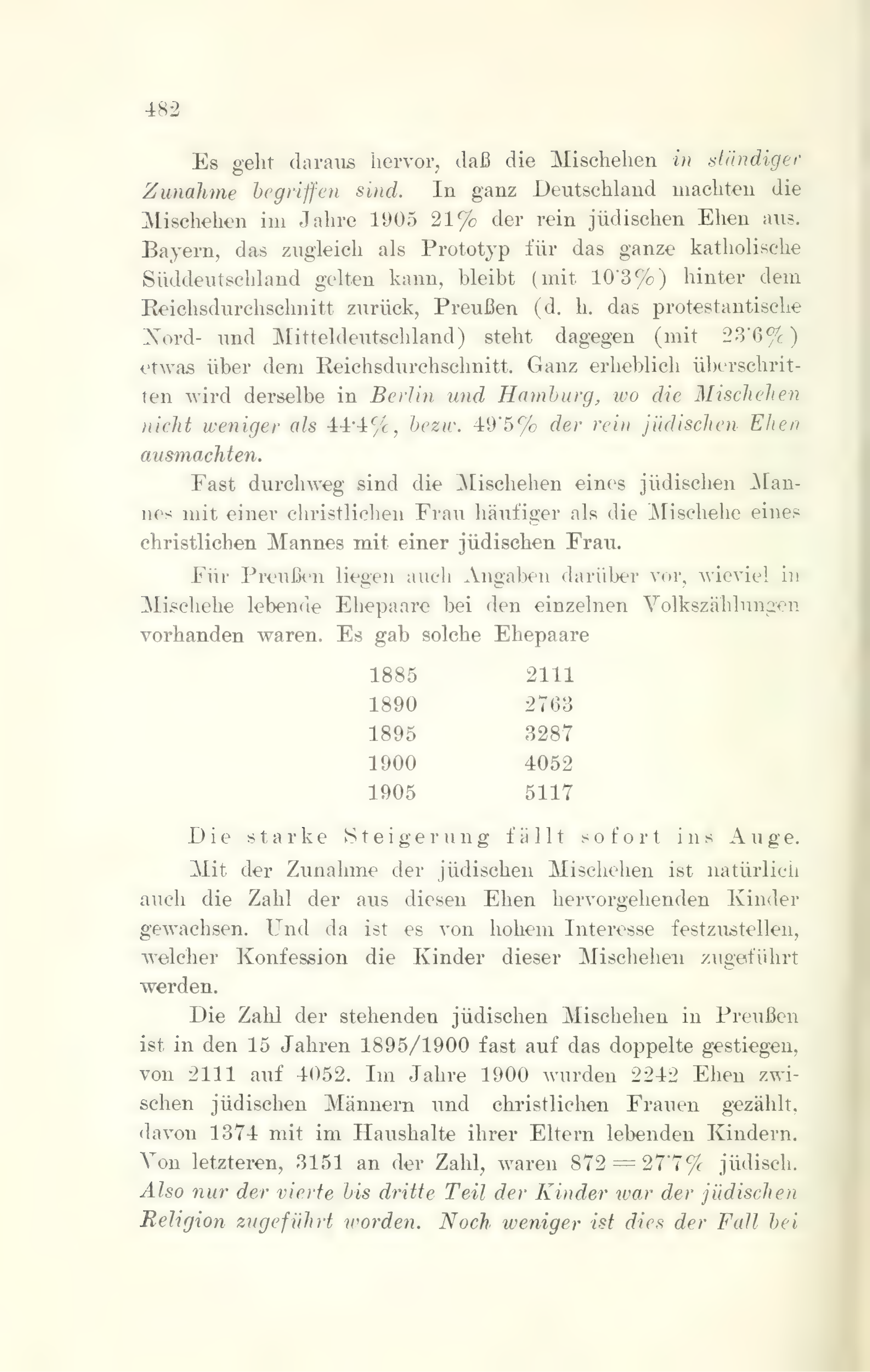
For Prussia, data are also available on how many married couples living in mixed marriages there were in the individual censuses. There were such married couples 1885 2111 1890 2763 1895 3287 1900 4052 1905 5117 The sharp increase is immediately apparent.
With the increase in Jewish mixed marriages, the number of children resulting from these marriages has naturally also grown. And here it is of great interest to determine to which denomination the children of these mixed marriages are assigned.
The number of existing Jewish mixed marriages in Prussia almost doubled in the 15 years 1895/1900, from 2111 to 4052. In the year 1900, 2242 marriages between Jewish men and Christian women were counted, of which 1374 had children living in their parents' household. Of the latter, 3151 in number, 872 - 27.7% were Jewish. Thus, only a fourth to a third of the children had been brought into the Jewish religion. This is even less the case with