480 considered) there were 326 purely Jewish and 159 mixed marriages. It is shown that the Jewish population of Denmark has not increased in the 60 years from 1840 to 1901, but has declined in absolute and even more in relative terms; in 1840, 0.299% of the total population was still Jewish, in 1901 only 0.142%. The proportion of Jews had thus fallen by more than half. The reason, besides a low number of children, is to be sought mainly in the numerous mixed marriages, through which the Danish Jews are gradually being absorbed by the Christian population.
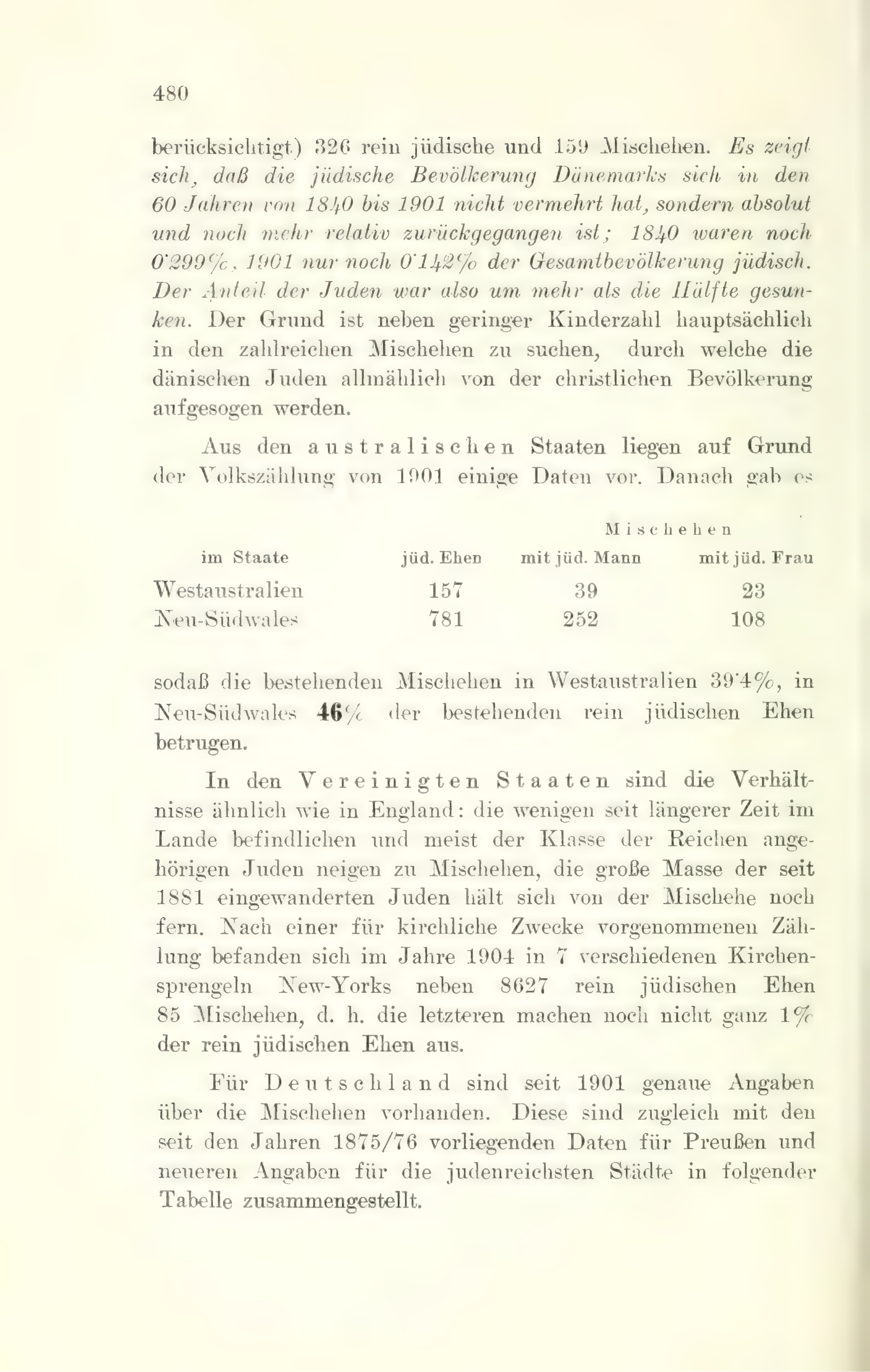
From the Australian states, some data are available based on the 1901 census. According to it, there were mixed marriages in the state Jewish marriages with Jewish man with Jewish woman Western Australia 157 39 23 New South Wales 781 252 108 so that the existing mixed marriages in Western Australia amounted to 39.4%, and in New South Wales 46% of the existing purely Jewish marriages.
In the United States, the situation is similar to that in England: the few Jews who have been in the country for a long time and mostly belong to the wealthy class tend to mixed marriages, while the great mass of Jews who immigrated since 1881 still refrain from mixed marriage. According to a census conducted for church purposes, in 1901 in 7 different church districts of New York, there were 85 mixed marriages alongside 8627 purely Jewish marriages, i.e., the latter make up not quite 1% of the purely Jewish marriages.
For Germany, exact data on mixed marriages have been available since 1901. These are compiled in the following table together with the data for Prussia available since the years 1875/76 and more recent data for the cities with the largest Jewish populations.