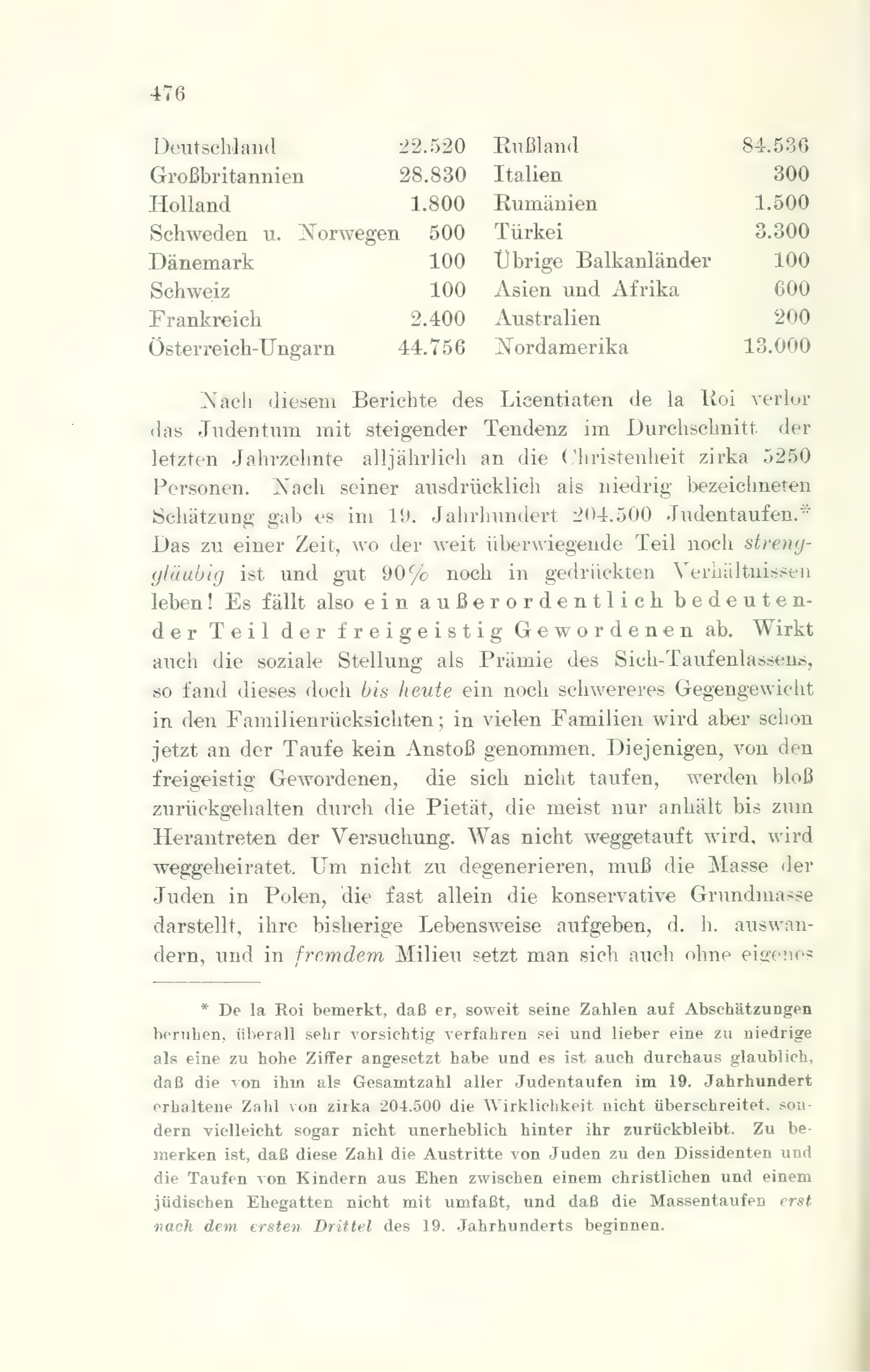
476 Germany 22,520 Russia 84,536 Great Britain 28,830 Italy 300 Holland 1,800 Romania 1,500 Sweden and Norway 500 Turkey 3,300 Denmark 100 Other Balkan countries 100 Switzerland 100 Asia and Africa 600 France 2,400 Australia 200 Austria-Hungary 44,756 North America 13,000
According to this report by Licentiate de la Roi, Judaism, with an increasing tendency, lost approximately 5250 persons to Christianity annually in the average of the last decades. According to his estimate, which he explicitly described as low, there were 204,500 Jewish baptisms in the 19th century.*
And this at a time when the vast majority is still strictly devout and a good 90% still live in oppressed circumstances! Thus, an extraordinarily significant part of those who have become freethinkers is falling away. Even if social position acts as a premium for getting baptized, this has until today found an even weightier counterbalance in family considerations; in many families, however, baptism is already no longer a cause for offense. Those among the freethinkers who do not get baptized are merely held back by piety, which usually only lasts until temptation approaches. What is not baptized away is married away. In order not to degenerate, the mass of Jews in Poland, who almost alone represent the conservative base, must give up their previous way of life, i.e., emigrate, and in a foreign milieu one comes into contact with the "spirit of the
- De la Roi remarks that, insofar as his numbers are based on estimations, he proceeded very cautiously everywhere and preferred to set a number too low rather than too high, and it is also entirely believable that the number he obtained as the total of all Jewish baptisms in the 19th century, of circa 204,500, does not exceed reality, but perhaps even falls not inconsiderably short of it. It should be noted that this number does not include the secessions of Jews to the Dissenters and the baptisms of children from marriages between a Christian and a Jewish spouse, and that the mass baptisms only begin after the first third of the 19th century.