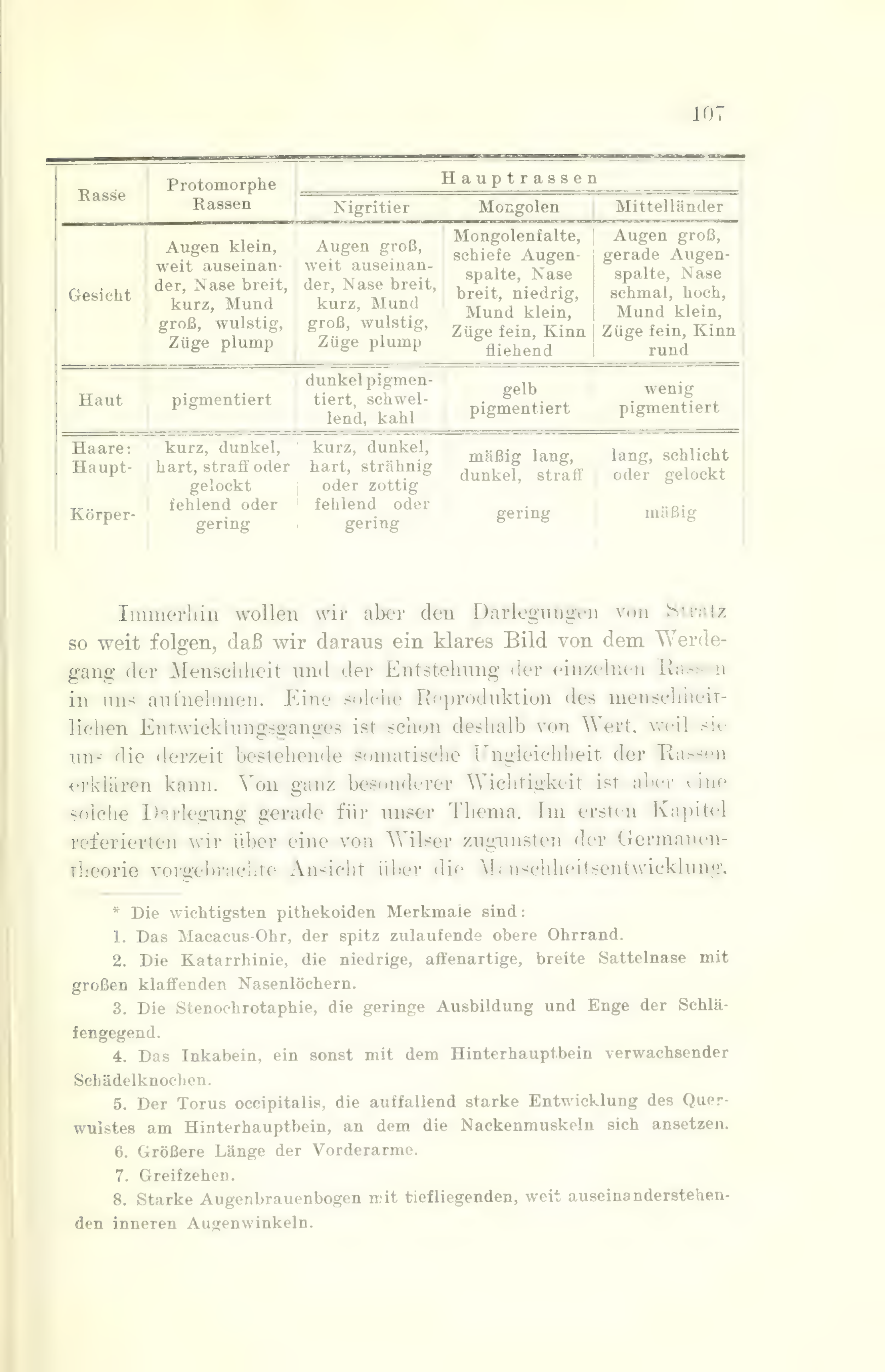
107 Main Races Race Protomorphic Races Negritian Mongols Mediterraneans Face Eyes small, Eyes large, Epicanthic fold, Eyes large, far apart, far apart, slanted palpe- straight palpe- nose broad, nose broad, bral fissure, bral fissure, short, mouth short, mouth nose broad, nose narrow, large, thick- large, thick- low, mouth high, mouth lipped, fea- lipped, fea- small, features small, features tures coarse tures coarse fine, chin fine, chin round receding Skin pigmented darkly pig- yellow little mented, swel- pigmented pigmented ling, hairless Hair: Head- short, dark, short, dark, moderately long, long, straight hard, straight hard, stringy dark, straight or curled or curled or shaggy Body- absent or absent or slight moderate slight slight
Nevertheless, we want to follow the explanations of Stratz so far as to gain a clear picture of the evolution of humanity and the origin of the individual races. Such a reproduction of the human developmental course is valuable because it can explain to us the currently existing somatic inequality of the races. But such a presentation is of very special importance precisely for our topic. In the first chapter, we reported on a view presented by Wilser in favor of the Germanic theory regarding human development.
- The most important pithecoid features are:
- The Macacus ear, the pointed upper edge of the ear.
- Catarrhiny, the low, ape-like, broad saddle nose with large, gaping nostrils.
- Stenocrotaphy, the slight development and narrowness of the temp- oral region.
- The Inca bone, a cranial bone otherwise fused with the occipital bone.
- The torus occipitalis, the strikingly strong development of the trans- verse ridge on the occipital bone, to which the neck muscles attach.
- Greater length of the forearms.
- Prehensile toes.
- Strong eyebrow ridges with deep-set, far-apart inner corners of the eyes.