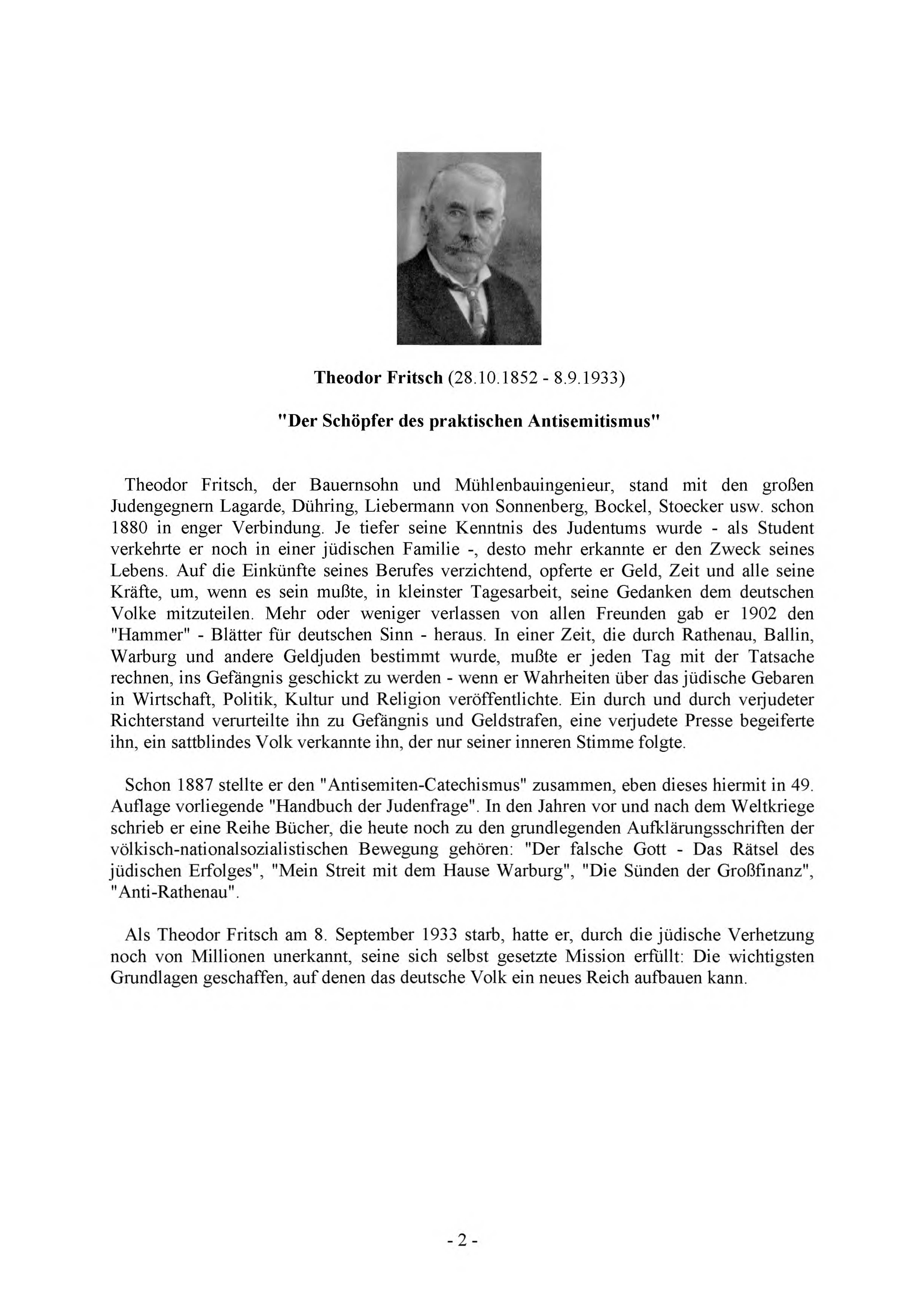
Theodor Fritsch.
Theodor Fritsch (28.10.1852 - 8.9.1933) "The Creator of practical Anti-Semitism"
Theodor Fritsch, the farmer's son and mill construction engineer, was already in close contact with the great opponents of the Jews Lagarde, Dühring, Liebermann von Sonnenberg, Böckel, Stoecker etc. in 1880. The deeper his knowledge of Judaism became - as a student he still associated with a Jewish family - the more he recognized his life's purpose. Forgoing the income from his profession, he sacrificed money, time, and all his energy to communicate his thoughts to the German people, in the smallest daily work, if need be. More or less abandoned by all his friends, in 1902 he published the "Hammer" - Papers for the German Mind. In an era that was defined by Rathenau, Ballin, Warburg, and other money Jews, he had to reckon every day with the fact of being sent to prison - if he published truths about Jewish conduct in business, politics, culture, and religion. A thoroughly Jewified judiciary sentenced him to prison and fines, a Jewified press slandered him, a complacent and blind people misunderstood him, who only followed his inner voice.
As early as 1887, he compiled the "Anti-Semite's Catechism," which is this very "Handbook of the Jewish Question," now in its 49th edition. In the years before and after the World War, he wrote a series of books that are still among the foundational enlightenment publications of the Völkisch-National Socialist movement today: "The False God - The Riddle of Jewish Success," "My Dispute with the House of Warburg," "The Sins of High Finance," "Anti-Rathenau."
When Theodor Fritsch died on September 8, 1933, he had fulfilled the mission he set for himself, though still unrecognized by millions due to Jewish agitation: creating the most important foundations on which the German people can build a new Reich.
2