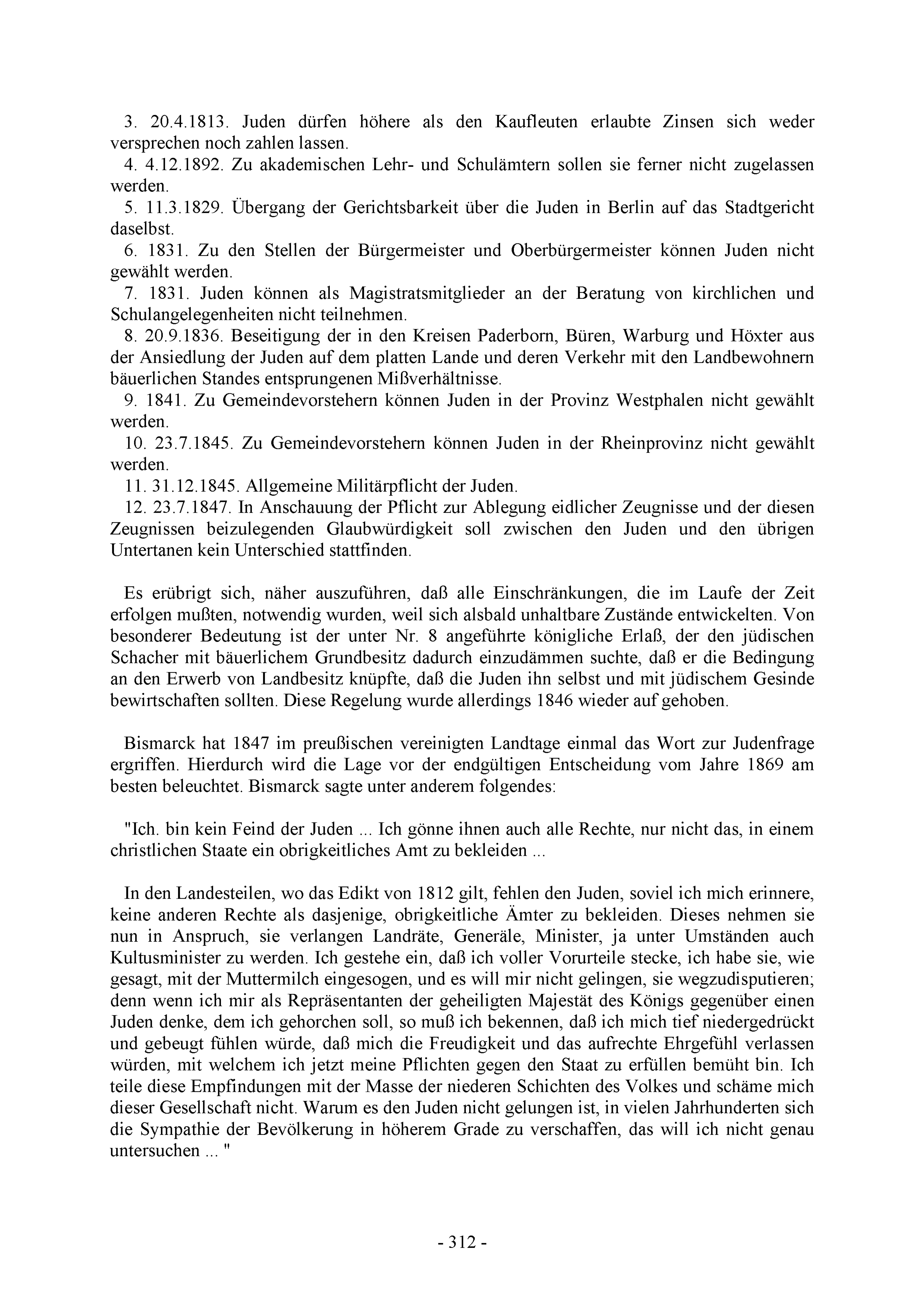
- 4/20/1813. Jews may neither be promised nor be paid higher interest rates than those allowed to merchants.
- 12/4/1892. They shall furthermore not be admitted to academic teaching and school offices.
- 3/11/1829. Transfer of jurisdiction over the Jews in Berlin to the city court there.
-
- Jews cannot be elected to the positions of mayor and lord mayor.
-
- Jews cannot participate as members of the magistrate in deliberations on church and school affairs.
- 9/20/1836. Elimination of the imbalances in the districts of Paderborn, Büren, Warburg, and Höxter that arose from the settlement of Jews in the countryside and their dealings with the rural peasant population.
-
- Jews cannot be elected as community leaders in the province of Westphalia.
- 7/23/1845. Jews cannot be elected as community leaders in the Rhine Province.
- 12/31/1845. General military duty for Jews.
- 7/23/1847. In view of the duty to give testimony under oath and the credibility to be accorded to this testimony, no distinction shall be made between Jews and the other subjects.
It is unnecessary to elaborate that all the restrictions that had to be imposed over time became necessary because untenable conditions soon developed. Of particular importance is the royal decree cited under No. 8, which sought to curb Jewish trafficking in peasant land by making the acquisition of land conditional on the Jews farming it themselves and with Jewish servants. This regulation was, however, repealed again in 1846.
Bismarck once took the floor on the Jewish question in the Prussian United Diet in 1847. This best illuminates the situation before the final decision of 1869. Bismarck said, among other things, the following:
“I am no enemy of the Jews... I grant them all rights, just not that of holding an office of authority in a Christian state... In those parts of the country where the Edict of 1812 is in force, the Jews, as far as I remember, lack no other right than that of holding offices of authority. They now lay claim to this; they demand to become district administrators, generals, ministers, and yes, under certain circumstances, even ministers of culture. I confess that I am full of prejudices; I have, as I said, imbibed them with my mother's milk, and I cannot manage to argue them away; for when I imagine, as a representative of the sacred majesty of the king, a Jew opposite me whom I am supposed to obey, I must confess that I would feel deeply oppressed and humbled, that the cheerfulness and upright sense of honor with which I now strive to fulfill my duties to the state would desert me. I share these feelings with the mass of the lower strata of the people and am not ashamed of this company. Why the Jews have not succeeded over many centuries in gaining the sympathy of the population to a higher degree, I do not wish to investigate in detail...” 312